The quantum anomalous Hall effect—a quantized Hall effect that exists even without an external magnetic field—remained a theoretical dream for 25 years. In 2013, a team led by Qi-Kun Xue at Tsinghua University realized it in an engineered magnetic topological insulator thin film, opening the door to practical applications of the exotic dissipationless quantum Hall edge states.
The integer and fractional quantum Hall effects (the discoveries that won Nobel Prizes in Physics, in 1985 and 1998, respectively) require strong magnetic fields, making them impractical for low-energy electronics. A zero-field version—the quantum anomalous Hall effect (QAHE)—would allow dissipationless edge currents without bulky magnets. However, realizing it in experiment requires a material that simultaneously satisfies three stringent conditions: a topologically nontrivial band structure, spontaneous long-range ferromagnetic order, and an insulating bulk. Meeting any one of these properties is already a major challenge for materials science; fulfilling all three seemed nearly impossible.
Starting in 2009, a team at Tsinghua set out on a remarkable journey towards the experimental realization of the quantum anomalous Hall effect. They chose the newly discovered Bi2Te3-family topological insulators as the matrix materials and employed a whole range of powerful experimental techniques, including molecular beam epitaxy, scanning tunneling microscopy, photoemission spectroscopy, and low-temperature transport measurements.
They first established the molecular beam epitaxy growth kinetics of Bi2Te3-family topological insulators and obtained ultrathin films with unprecedented quality. Carefully scrutinizing the effects of chemical composition, magnetic doping, film thickness, and surface morphology on the electronic and magnetic properties of a wide variety of composite topological insulator materials, they found a complex quaternary compound Cr-doped (Bi,Sb)2Te3 as the optimal material system for realizing the QAHE.
Eventually, in late 2012, they observed the quantized Hall resistance (h/e2) (~25.813 kΩ) at zero magnetic field for the first time in history. The discovery, published in Science in 2013, was later confirmed and repeated by several groups worldwide, which unambiguously confirmed the discovery. It concluded a 25-year search for the zero-field quantum Hall effect and resolved half-century-old debates about the intrinsic anomalous Hall effect.
The Scientific Background for the 2016 Nobel Prize in Physics by the Royal Swedish Academy of Sciences says “This phase of matter described by Haldane is now called a Chern insulator, and twenty five years later, in 2013, a quantized Hall effect was observed in thin films of Cr-doped (Bi,Sb)2Te3 at zero magnetic field, thus providing the first experimental detection of this phase of matter”. It highlights the discovery as the main experimental support of the theoretical contribution of F. D. M. Haldane, the Nobel Prize laureate this year.
In recent years, rapid progress has been made in the exploration of higher temperature QAHE and quantum metrology applications of QAHE. QAHE has been achieved in intrinsic magnetic topological insulators, ultracold atom systems, and several moiré superlattice systems. Fractional QAHEs have been observed in recent years. These following advances have made QAHE one of the most rapidly growing fields in condensed matter physics, which would drive novel quantum Hall states from a puzzle of fundamental physics to practical applications in electronics, metrology, and quantum information.
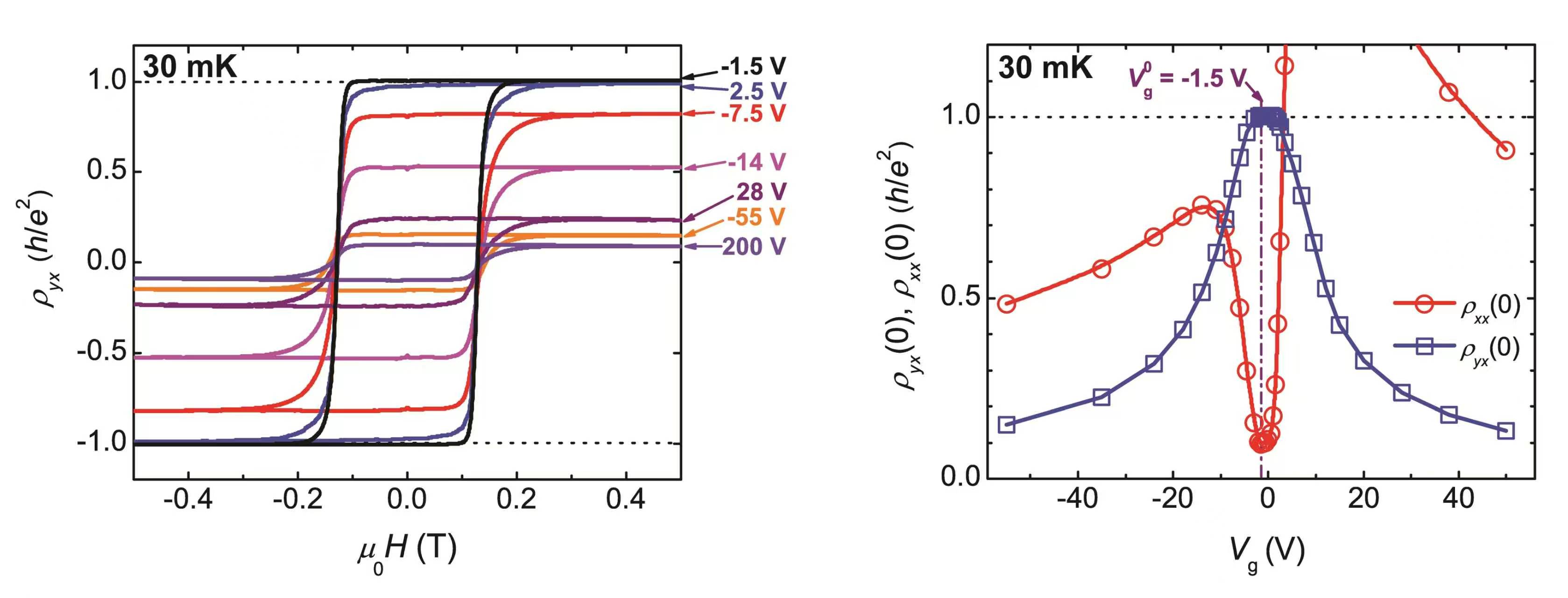
Transport measurement data exhibiting the quantum anomalous Hall effect. Credit: Science 340, 167 (2013)
Read the full paper:
Science, DOI: 10.1126/science.1234414