The sensitized fluorescence approach decouples the harnessing of triplet excitons from the radiative decay of singlets within a single molecule, thereby overcoming the long-standing efficiency–stability trade-off in blue OLEDs for practical applications.
Blue organic light-emitting diodes (OLEDs) have long represented the most stubborn bottleneck in the development of energy-efficient, long-lasting displays. The pursuit of stable and efficient blue emission has been hampered by a fundamental trade-off: materials that achieve high efficiency tend to degrade rapidly, whereas stable emitters often lack sufficient brightness. This conflict arises because triplet harvesting and radiative decay are intrinsically incompatible processes on a single molecule, which prolongs the excited-state lifetime and leads to exciton annihilation. This compromise has limited the performance and longevity of consumer electronics, from smartphones to large-screen TVs.
A research group led by Professor Lian Duan at Tsinghua University has now pioneered a solution with the introduction of a fourth-generation OLED technology: TADF-sensitized fluorescence (TSF). Moving beyond conventional fluorescence, phosphorescence, and thermally activated delayed fluorescence (TADF) mechanisms, the TSF approach cleverly separates the processes of triplet exciton utilization and light emission. Here, a TADF molecule acts as a “sensitizer” to harvest triplet excitons, then efficiently transfers the energy to a separate fluorescent emitter that radiates light. This elegant decoupling of triplet harvesting from singlet emission within a single molecular system simultaneously overcomes the historic efficiency-stability trade-off. Moreover, when a narrowband final emitter is adopted, TSF could provide high color purity emission that satisfies the requirement of BT.2020, a color gamut standard for the ultrahigh-resolution displays.
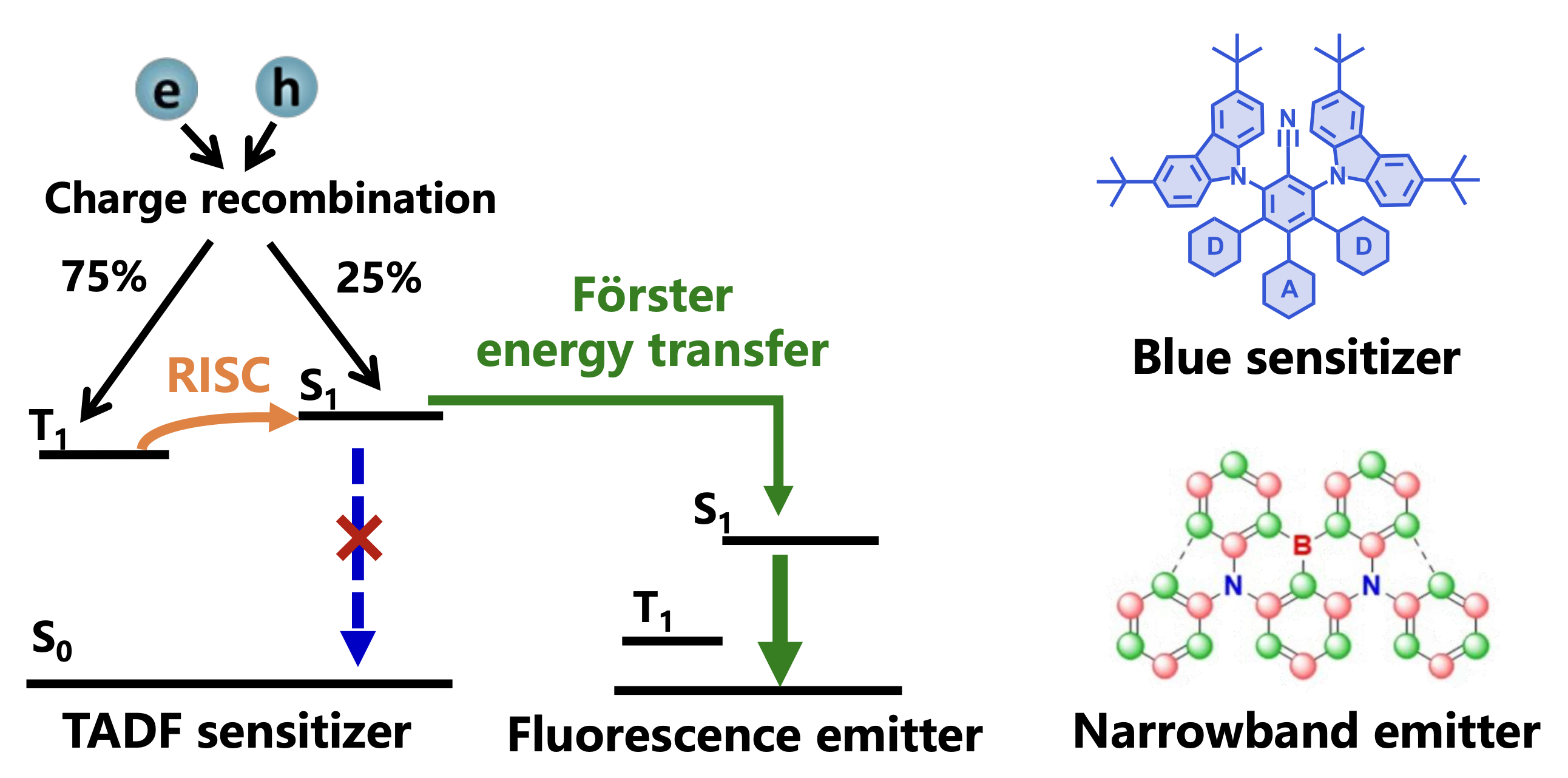
The energy transfer process of the TSF process, as well as the scheme for the molecule structure for the sensitizer and narrowband emitter. Credit: Tsinghua University
Building upon this TSF architecture, Prof. Duan’s team engineered two key components: highly stable blue TADF sensitizers and novel narrowband fluorescence emitters. The sensitizer ensures efficient triplet-to-singlet conversion, while the specialized fluorescent emitter delivers pure, saturated color. This synergistic combination has yielded blue OLEDs that set new performance benchmarks, achieving the longest operational lifetime reported for blue devices alongside high efficiency, thereby paving a concrete technological pathway toward real-world application.
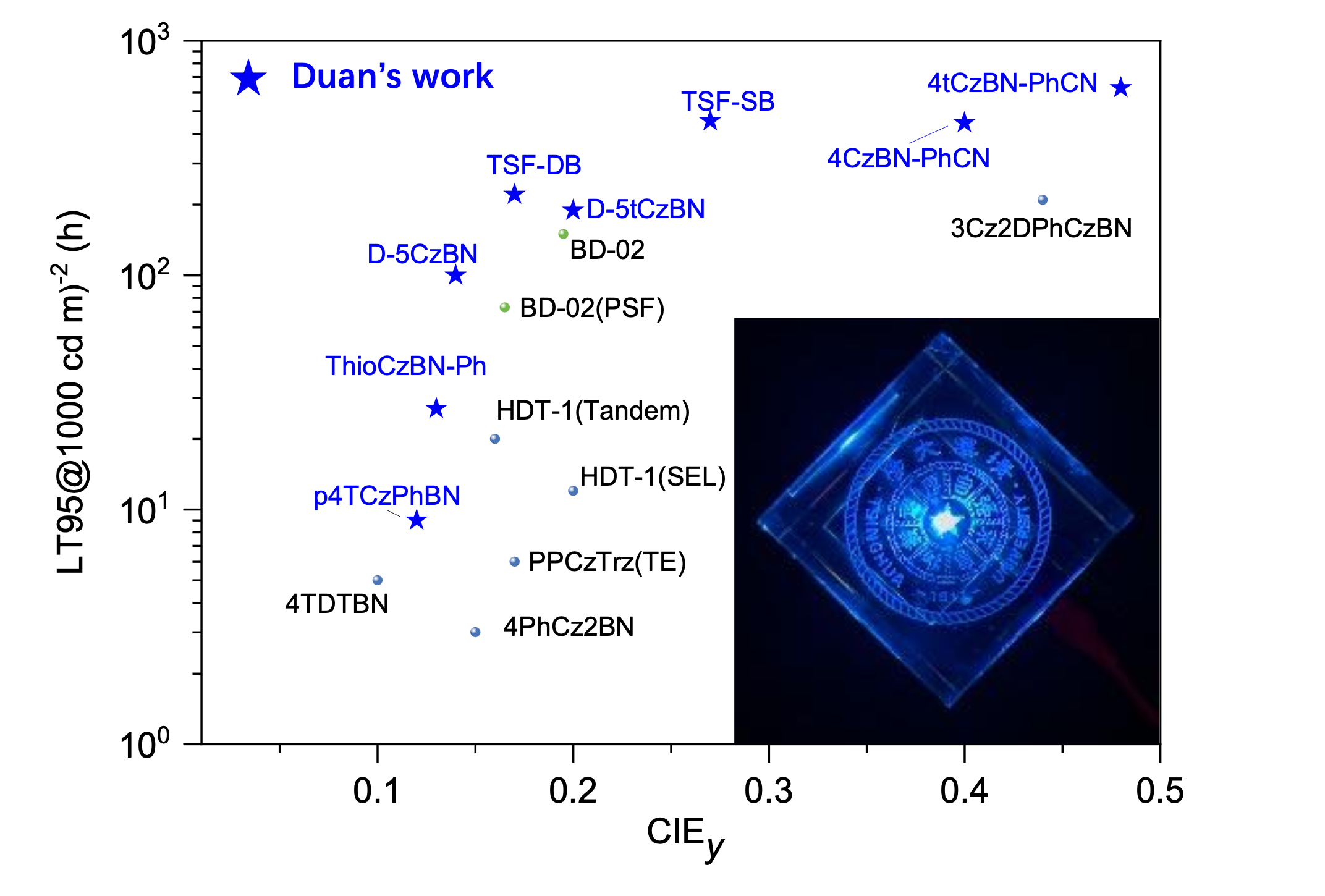
A summary of the stability of blue OLEDs in the literature. Credit: Tsinghua University
“TSF also stands for Tsinghua Fluorescence. The strategy fundamentally changes the design rules for blue OLEDs,” explained Prof. Duan. “By separating the functions, we can independently optimize stability and color purity without compromising one for the other. This marks a decisive step from laboratory innovation toward industrial application.”
Looking ahead, the researchers suggest that future work will focus on further broadening the color gamut, pushing the stability limits for deep-blue emission, and integrating these materials into large-area, flexible display prototypes. The successful demonstration of TSF technology is expected to accelerate the development of the next generation of displays that are not only vivid and energy-saving but also exceptionally durable.
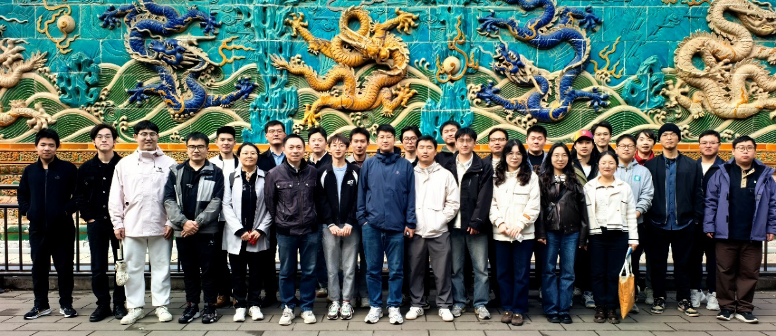
The picture of Duan’s group. Credit: Tsinghua University
Read the full papers:
Nature Materials, DOI: 10.1038/s41563-024-02004-w
Nature Materials, DOI: 10.1038/s41563-026-02529-2
Nature Photonics, DOI: 10.1038/s41566-025-01810-1
Nature Photonics, DOI: 10.1038/s41566-024-01379-1
Advanced Materials, DOI:10.1002/adma.201908355
Advanced Materials, DOI: 10.1002/adma.201401476