Researchers have built a two-dimensional trapped-ion quantum simulator that can perform quantum simulations beyond the reach of classical computers. This breakthrough paves the way for scaling up the number of controllable qubits to hundreds — a critical step for both quantum simulation and quantum computing — with potential applications ranging from fundamental physics to information security.
Trapped ions hold a special place in quantum computing history: the very first two-qubit quantum logic gate was implemented in this platform. Today, trapped ions remain one of the most promising candidates for building a universal quantum computer. The main challenge, however, lies in scaling up the number of physical qubits without sacrificing the fidelity of quantum operations.
In room-temperature systems and conventional one-dimensional ion chains, scaling is severely limited by collisions with background gas and by the achievable radio-frequency pseudopotential before reaching the breakdown voltage between electrodes. Over the past decade, the largest ion crystals used for quantum information processing in Paul traps have contained only about dozens of qubits.
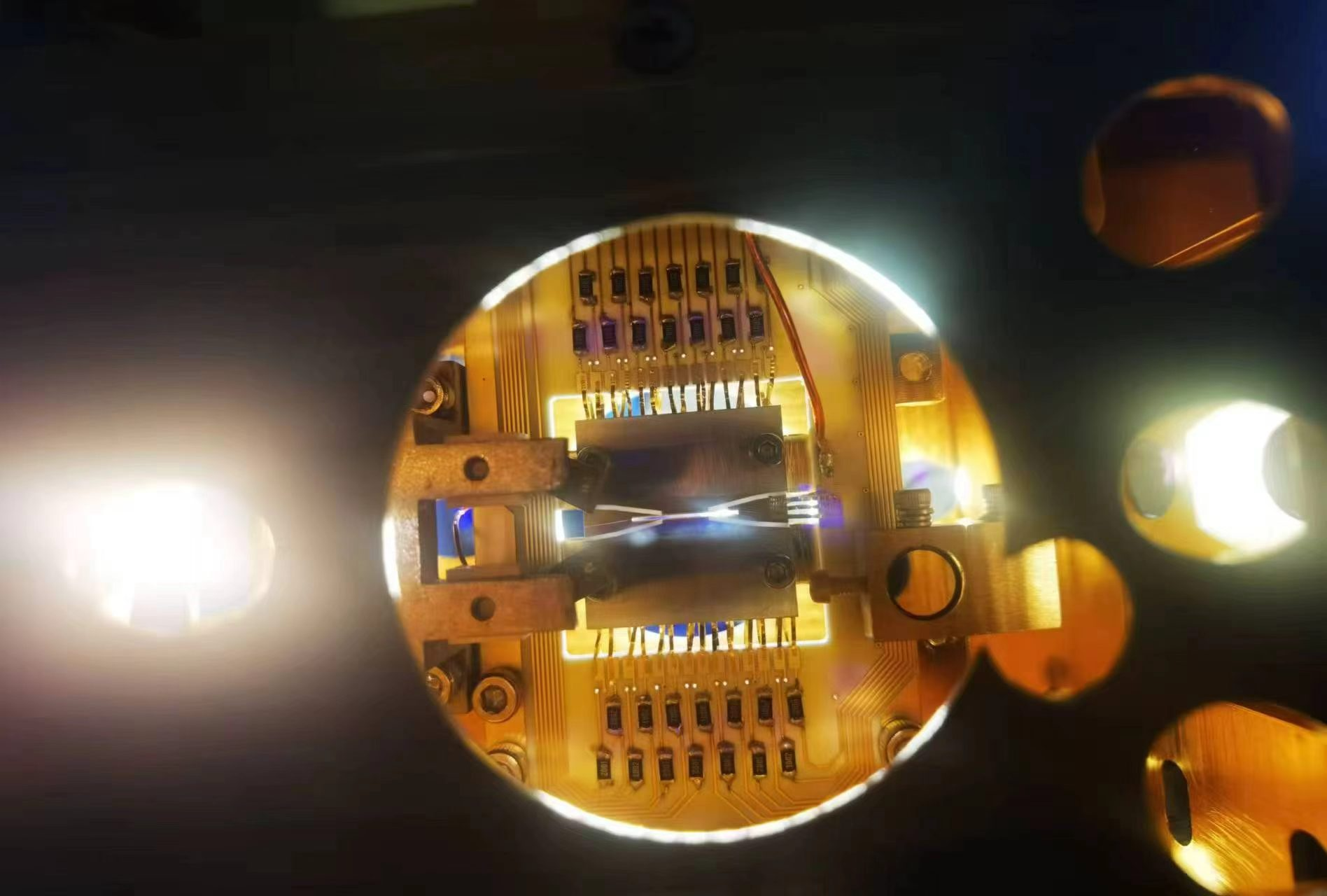
The 3D monolithic ion trap installed inside vacuum chamber, taken by a team at Tsinghua University. Credit: Tsinghua University
A quantum simulator with 300 ions performs site-resolved simulation of many body physics model
Now, a team of researchers at Tsinghua University has developed a new approach. Using a monolithic three-dimensional ion trap operating at cryogenic temperatures (around 6 kelvin), they have successfully trapped a two-dimensional ion crystal consisting of 512 ions. After Doppler cooling and sideband cooling, the entire ion crystal can be initialized to its ground state.
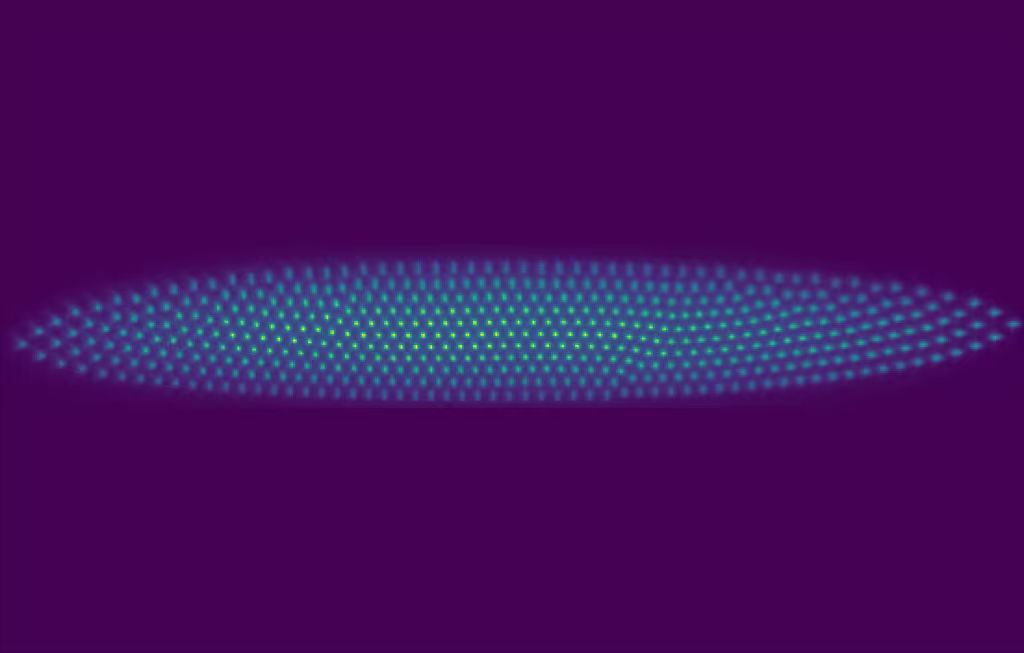
The image of a 2D ion crystal with 512 ions, taken by a team at Tsinghua University, published at Nature 630, 614 (2024). Credit: Tsinghua University
By applying counter-propagating off-resonant laser beams together with a global microwave field, the researchers performed quantum simulations of the long-range Ising model using 300 ions. They further achieved Hamiltonian learning for the all-to-all coupled Ising model — all with global manipulations and single-qubit-resolved state detection.
Because the Hilbert space grows exponentially with the number of qubits, simulating quantum dynamics and verifying simulation results are notoriously difficult for classical computers. This new quantum simulator platform overcomes that barrier. By dynamically tuning coupling strengths and patterns, the researchers can prepare the ground state of the Ising Hamiltonian or observe dynamical phase transitions. With hundreds of qubits and single-site detection, many-body dynamics become clearly visible through measured spatial spin-spin correlation patterns.
Future Directions
The current use of a 300-ion two-dimensional crystal is limited only by available laser power for strong couplings — not by any fundamental constraint. With more precisely fabricated monolithic ion traps and better vacuum pressure, this approach could scale to thousands or even tens of thousands of ions. Moreover, by integrating a two-dimensional individual addressing system, high-fidelity two-qubit quantum gates could be implemented, offering a promising architecture for a future universal quantum computer based on trapped ions.
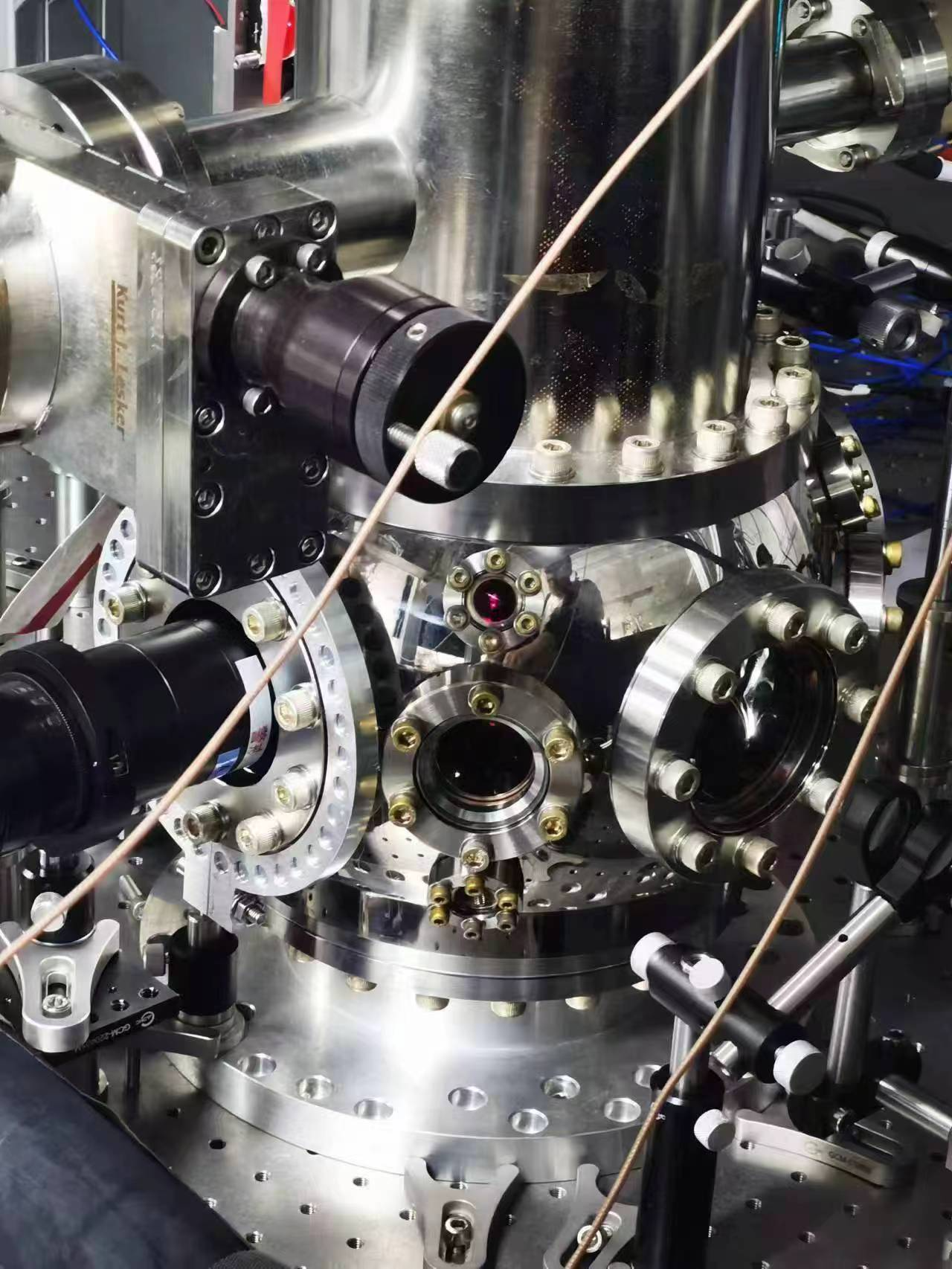
The vacuum chamber of cryogenic ion trap, taken by a team at Tsinghua University. Credit: Tsinghua University
Read the full papers:
1. Nature, DOI: 10.1038/s41586-024-07459-0
2. Science Advances, DOI: 10.1126/sciadv.adt4713