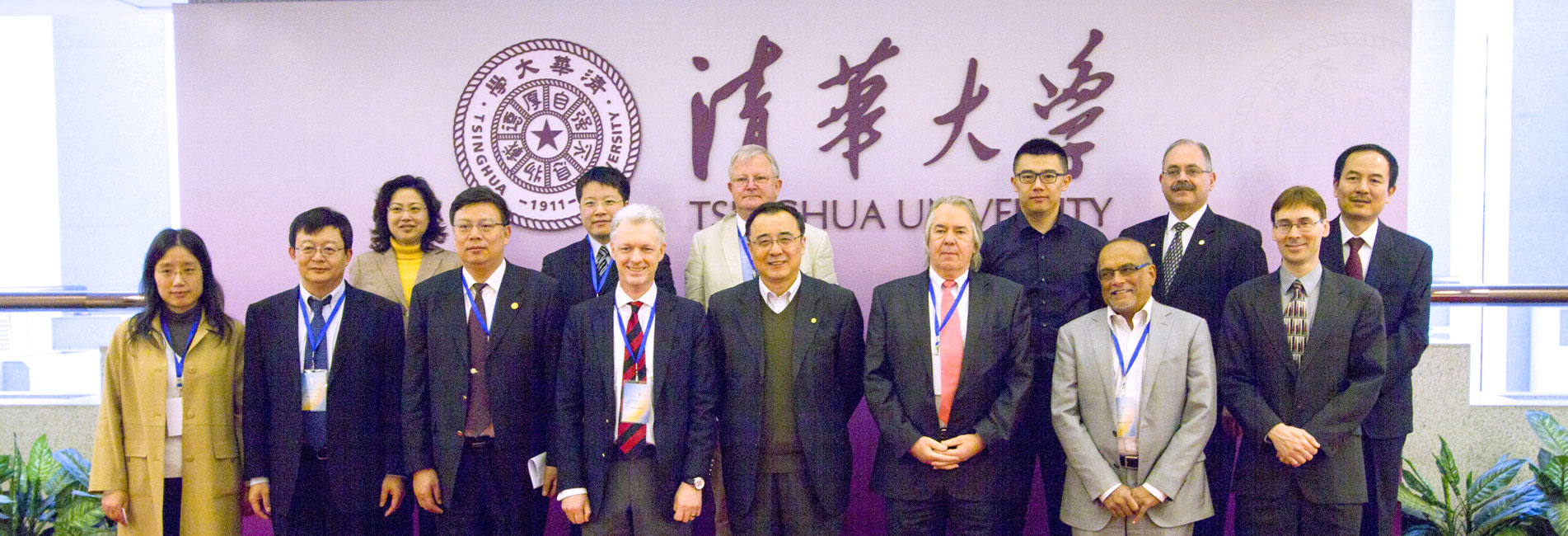
The Precision Instrumentation Department jointly organized a special teaching training for young teachers with the Department Trade Union and Teaching Committee in Conference Room 401 of the department building on the morning of January 16, 2026. This training invited Liang Sisi, Deputy Dean of Zijing College, as well as experienced teachers from the Precision Instrumentation Department including Dong Yonggui and Sun Liqun, to share their teaching insights and experiences with young teachers. Nearly 40 teachers participated in the exchange. At the beginning of the training, Liang Sisi was the first to share, providing a detailed introduction to the construction of Zijing College and the teacher-student interaction model in its courses. Combined with her own teaching practice, she disassembled practical techniques in classroom teaching, offering interdisciplinary teaching ideas for young teachers.
Bao Chengying from the Optoelectronics Research Institute and Deng Lei from the Instrumentation Research Institute respectively demonstrated their teaching methods and presented course design ideas around the topics of "Light Interference" and "AI Chip Design Principles" during the young teachers' teaching demonstration segment, intuitively showcasing their respective teaching styles and pedagogical logic.
Upon the demonstrations, the attending experts provided point-by-point guidance and feedback, affirming the strengths while precisely identifying areas for improvement and offering targeted suggestions.
In line with the demonstration content, Liang Sisi offered five specific guidance points: First, she recommended that young teachers actively participate in the subsequent interdisciplinary training programs organized by the university. Second, they should clarify the core objectives of their courses, focusing on key knowledge points by combining with the learning profiles of Tsinghua students. Third, they should optimize teaching logic, analyzing layer by layer to enhance knowledge transmission efficiency. Fourth, they should master the depth of explanations, taking into account audiences with different professional backgrounds, achieving the effect of "allowing non-expert judges to understand the core of the teaching while also perceiving the professional depth behind the formulas". Fifth, they should select topics precisely—content should originate from textbooks while exceeding them, and at the same time, deeply explore core difficulties to guide students in active thinking.
Dong Yonggui put an emphasis on the differences between teaching competitions for young teachers and daily teaching, offering improvement suggestions: First, transform the teaching perspective—design courses based on "what students want to hear" rather than simply centering on "what I want to teach". Second, control the speaking pace—if time is tight, prioritize condensing content rather than speeding up, to avoid affecting the learning experience due to overly fast speaking.
Sun Liqun attached importance to improving course quality, providing targeted opinions: First, distinguish between popular science teaching and professional teaching—preset students' knowledge background before teaching, clarify the connection between new and old knowledge points, and precisely locate the core content of the course. Second, adapt to teaching requirements in the AI era—classrooms need to explore "knowledge points that students cannot breakthrough through independent study", guide thinking through in-depth analysis and problem design. For example, regarding core content such as interference, phase difference, and wave nature, set thought-provoking questions to stimulate students' desire to explore.
Besides, Xiao Qirong and Zhao Xiaoguang, last year's first prize winners of the Tsinghua University Young Teachers Teaching Competition, provided a detailed breakdown of the two teachers' demonstration courses from dimensions such as teaching content arrangement, classroom presentation techniques, and teacher-student interaction design, offering actionable optimization plans. The attending young teachers actively participated in the exchange, conducting in-depth discussions around the key points of feedback and teaching difficulties.
Department Director Liu Qiang generally recognized the course demonstrations by the two teachers while offering core suggestions: Classroom teaching should avoid "container-style" indoctrination—while ensuring rich content, teachers should also proactively "open windows" to build bridges of teacher-student interaction, allowing students to not only receive knowledge but also participate in thinking and actively explore.
Based on the "demonstration + feedback + exchange" model, this training provided a platform for young teachers to learn from each other and promote mutual progress, effectively sorting out the core key points and improvement directions in teaching, laying a solid foundation for enhancing young teachers' teaching abilities and consolidating teaching quality.