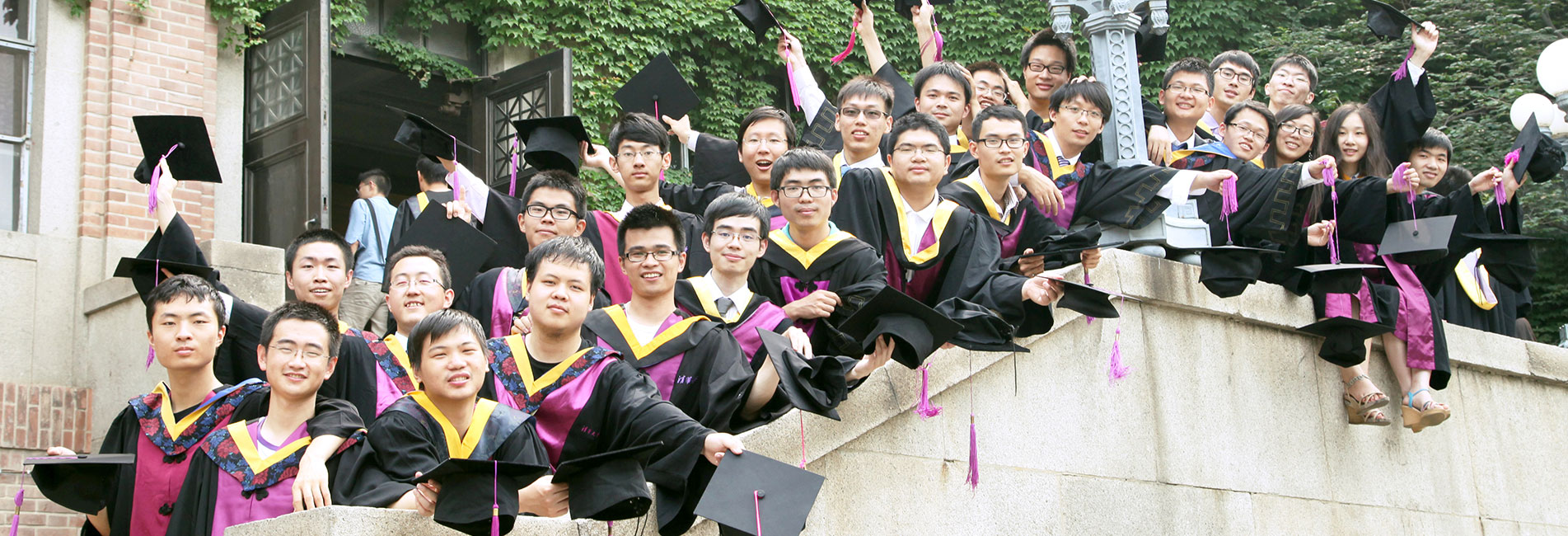
The Precision Instruments Department focuses on professional training by following the "Measurement and Control Technology and Instruments", a characteristic program in higher education. Passing the Engineering Education Professional Certification in 2013, it adopted a credit system with flexible learning years for undergraduate education. Students who complete and meet the program requirements are awarded a Bachelor of Engineering degree. Outstanding graduates can directly pursue master and doctoral degrees. Since 2013, the "Cultivating Outstanding Talents" program has been implemented, assigning a mentor to each new undergraduate student. Renowned professors, including academicians and Chang Jiang Scholars,teach undergraduate courses, and foreign professors from well-known universities are invited to teach short courses. Among the courses offered, there are 2 national-level excellent courses, 3 Beijing municipal excellent courses, and 9 Tsinghua University excellent courses. Three courses have become massive open online courses at Tsinghua University. In 2020, four courses—"Fundamentals of Testing and Measurement Technology", "Fundamentals of Optical Engineering", "Fundamentals of Control Engineering", and "Optoelectronic Instrument Design"—were recognized as the first batch of national first-class undergraduate courses. In recent years, faculty members have published over 30 undergraduate textbooks. The textbook series "Fundamentals of Control Engineering (3rd Edition)", "Fundamentals of Control Engineering (3rd Edition) Exercise Solutions", and "Fundamentals of Control Engineering Laboratory Guide" were selected into the second batch of the "12th Five-Year Plan" for national-level undergraduate planning textbooks by the Ministry of Education. In 2020, the department won the Tsinghua University Annual Teaching Excellence Award and the Young Teacher Teaching Excellence Award. In 2021, it won the Tsinghua University Teaching Achievement Award and the National Excellent Textbook Second Prize, and four courses were rated as Tsinghua University excellent courses. In 2022, we won first, second, and third prizes in the engineering group of the 10th Tsinghua University Young Teacher Teaching Competition. In 2023, one course was newly recognized as a Tsinghua University excellent course. In 2024, we won the first prize of the China Instrument and Control Society Higher Education Teaching Achievement Award, the Tsinghua University Annual Teaching Excellence Award, two Tsinghua University excellent courses (re-evaluation), and three first prizes in the engineering group of the 11th Tsinghua University Young Teacher Teaching Competition. The department provides opportunities for outstanding students to excel through programs like the "Top-notch Innovative Student Training Project" and various science and technology competitions.
The Precision Instruments Department engages in the construction of Weiyang College, offering comprehensive support for its talent cultivation. This support assists students in growing into high-quality talents with innovative abilities and international perspectives.The department offers high-level courses and practical resources in fields such as precision instruments, optical engineering, and measurement and control. We collaborate with Weiyang College to build the "Technology Innovation and Challenge (TIC)" training module, sharing laboratories, research platforms, and equipment to support students' research training and innovation practices.The department offers several core and elective courses for Weiyang College students, covering areas such as instrument science, optical technology, and sensor technology, helping students build a solid professional foundation. The course design emphasizes the combination of theory and practice, cultivating students' practical skills and problem-solving abilities.The department encourages Weiyang College students to participate in research projects, providing mentor guidance and laboratory resources to help them engage with cutting-edge technology. Through research participation, students can enhance their innovative thinking and research capabilities, laying the foundation for future academic or career development.The department promotes interdisciplinary collaboration, facilitating exchanges between students and faculty from different professional backgrounds to broaden students' horizons. Through interdisciplinary projects, students' comprehensive abilities and teamwork skills are strengthened.
Being a leading engineering department in China, the Precision Instruments Department leverages its strengths in precision instruments and optical engineering to offer interdisciplinary courses for Weiyang College students. For instance, courses like "Micro-Electro-Mechanical Systems Design" and "Optoelectronic Technology" combine basic disciplines such as mathematics and physics with engineering technologies like precision measurement and intelligent sensing, helping students build a knowledge system of "basic theory + engineering application". The department participates in the formulation of Weiyang College's training program, promoting the construction of core courses and the integration of course modules. For instance, we integrate control theory and signal processing into the students' mathematics and physics foundation courses, strengthening engineering thinking training. Through course innovation, openness of research resources, enhancement of practical abilities, and construction of an academic ecosystem, the department provides core support for Weiyang College's goal of cultivating "solid foundation, interdisciplinary, and strong innovation" talents. This not only promotes the deep integration of basic disciplines and engineering technologies but also helps Weiyang students become leaders in future technology fields.
The Precision Instruments Department attaches importance to continuously exploring a teaching system that matches the curriculum construction and planning of the colleges, which adopts an experimental and practical teaching model that emphasizes "exploratory" cognition, verification, application, and challenge, running through all four years of university education. By applying basic knowledge in practice, students gain a stronger sense of accomplishment in their learning process. Strengthening the guidance for students' interest in engineering, the department stimulates their enthusiasm for self-directed learning and using their knowledge to solve practical problems, and gives students ample time and credit space to carry out active learning and innovative exploration.