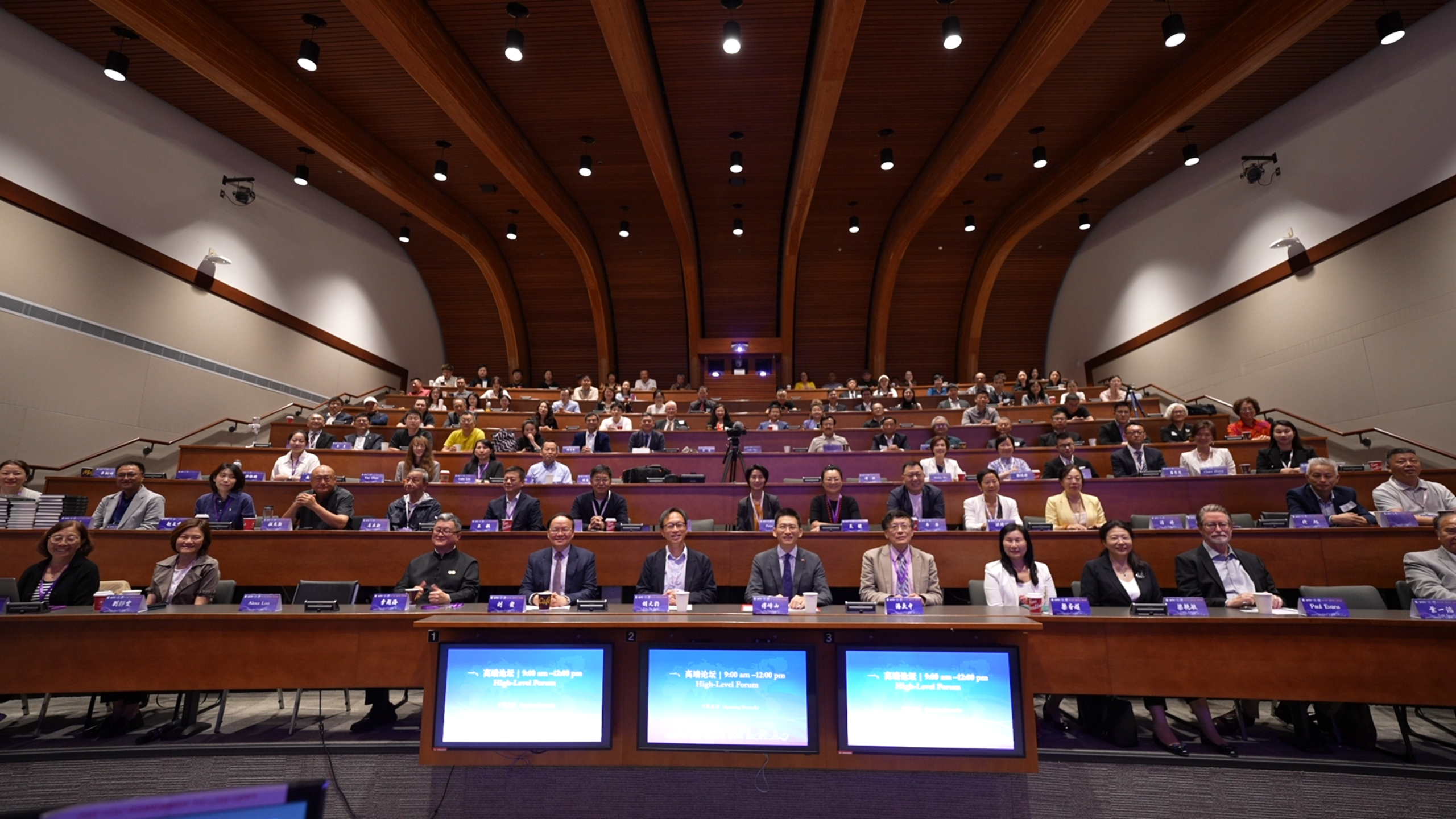
On August 1, the 16th Overseas Chinese Entrepreneurs Tsinghua Forum (Vancouver) was held at the Sauder School of Business, University of British Columbia (UBC), Vancouver, Canada. Hosted by the Center for Chinese Entrepreneur Studies (CCES) at Tsinghua University and the Chinese Entrepreneurs Society of Canada (CESC), the forum featured in-depth discussions among attendees on the shifting global landscape, digital economy, the Belt and Road Initiative (BRI), China-Canada economic and trade collaboration, and the inheritance of the overseas Chinese entrepreneurs network.
Fu Fengshan, Consul General of the People's Republic of China in Vancouver, and Long Denggao, Director of CCES, delivered keynote addresses. Yuen Pau Woo, Canadian Senator, Li Wenhai, Vice President of Charoen Pokphand Group and Chairman of Nanjing Tech University Pujiang Institute, and Liang Xingjuan, President of CESC, each delivered opening remarks. Representatives from the Consulate General of the People's Republic of China in Vancouver, including Counselor Liang Yanmin and Consul Fu Ting, joined the event. Parm Bains, Canadian Member of Parliament, and Alexa Loo, Councillor of Richmond City Council, sent written congratulatory messages. Zhang Kaiping, Vice Dean of the School of Social Sciences at Tsinghua University, presided over the opening ceremony. More than 150 guests from the political, academic and business circles participated in the forum.
Fu Fengshan noted that this year marks the launch of China's 15th Five-Year Plan. While delivering greater "market dividends", China is also offering the world increasing "innovation dividends". Since the start of this year, China and Canada have been actively delivering on the important consensus reached by leaders of both countries. Bilateral dialogue mechanisms have been fully restored, and cooperation in trade, energy, finance and other areas continues to yield tangible outcomes. China will stay committed to high-level opening-up, and deepen mutually beneficial cooperation with Canada and partners around the globe.
Looking back at the forum's 16-year development journey, Long Denggao articulated that the forum remains committed to its founding mission of "applying academic insights to understand the business world and leveraging industrial practices to enrich scholarly research", thereby fostering trilateral dialogue among academia, the business community, and public governance.
Yuen Pau Woo said that discussions at the forum will provide crucial insights for recalibrating China-Canada relations and elevating the quality of bilateral cooperation. Li Wenhai elucidated the essence of Teochew entrepreneurship, and summarized the spiritual foundation of Teochew ancestors who ventured overseas to start businesses, while remaining deeply connected to their homeland. Liang Xingjuan highlighted that focusing on four issues - cross-border economy and trade, digital economy, industrial innovation, and transnational operations - the forum assists overseas Chinese entrepreneurs in exploring new opportunities amid the shifting global landscape.
Liu Hong, Associate Vice President of Nanyang Technological University, Singapore and Tan Lark Sye Chair Professor, and Paul Evans, former Director of UBC Institute of Asian Research, delivered invited speeches successively; Prof. Chen Zhongping from the University of Victoria, Canada, Professor Emeritus Lin Xiaohua from Toronto Metropolitan University and Chair Professor Fang Tao from the Memorial University of Newfoundland delivered keynote speeches. The two sessions were moderated by Pan Qingzhong, Executive Dean of Schwarzman College, Tsinghua University, and Ying Lowrey, former Deputy Director of CCES, respectively.
The forum also featured a book launch themed "Dialogue with Teochew Entrepreneurs" and a symposium. Alice Wong, Life Member of the King's Privy Council for Canada, delivered a speech, while Xu Jinsong, Co-President of Canada Teochew Federation, and Fang Junhong, Honorary President of the Canton Chamber of Commerce Canada, shared their insights.