Ultrafine particles (aerodynamic diameter < 100nm) dominate the number concentration of atmospheric aerosols and exert profound impacts on human health and climate. Condensational growth significantly alters the size and chemical composition of ultrafine particles, further reshaping their climatic and health-related effects. For a long time, the long-term variations of chemical species that dominate the dynamic condensational growth of ultrafine particles remained poorly characterized, largely due to the absence of instruments and methodologies suitable for long-term field observations.
Hygroscopicity is indicative of aerosol chemical compositions. However, traditional Hygroscopic Tandem Differential Mobility Analyzers (HTDMA) require manual presetting of mode diameters, resulting in the fragmented observations of growth events. Such instruments also fail to capture ubiquitous rapid changes in condensation mechanisms and synchronous multi-modal growths in the atmosphere. The research group led by Assistant Professor Zheng Guangjie from the School of Environment, Tsinghua University, developed the Synchronous Monitor of Aerosol Size and Hygroscopicity (SMASH) which coupled a Scanning Mobility Particle Sizer (SMPS) with an HTDMA. Capable of synchronously tracking modal particle diameters and aerosol hygroscopicity with a high temporal resolution of 6 minutes, the SMASH provides a powerful tool to analyze the dynamic characteristics in dominant condensing species.
Observations and analyses of a ~30-hour continuous ultrafine particle condensational growth episode in summer Beijing demonstrate that the SMASH system can reliably track peak particle diameters and retrieve the hygroscopicity parameter κ throughout growth processes. Variations in κ enable the classification of distinct episodes including condensational growth and particle shrinkage (Fig. 1a and 1b). Theoretical calculations further allow researchers to distinguish hygroscopicity shifts of dominant condensing species across different episodes (Fig. 1c). Beyond single-mode growth tracking, SMASH captures simultaneous bi-modal growth of Aitken and accumulation modes, offering unique insights into the size-dependence of atmospheric condensation. Significant temporal variations in the hygroscopicity of condensing species support standardized classification of growth episodes and quantitative calculation of particle growth rates across distinct episodes, clarifying how different condensation mechanisms modulate growth dynamics. Featuring relatively low costs and easy maintenance, the SMASH system is suitable for large-scale long-term deployment across multiple monitoring sites to elucidate regional and seasonal variations in aerosol condensational growth mechanisms. Moreover, the instrument integration framework of SMASH can be extended to couple supplementary analytical devices (e.g., TD-CIMS, CPMA) to realize synchronous multi-parameter measurements of molecular composition and density. This integrated approach can generate comprehensive characteristic profiles of condensing species and supply constrained parameters of condensing species hygroscopicity and growth rates for regional and global atmospheric chemical models.
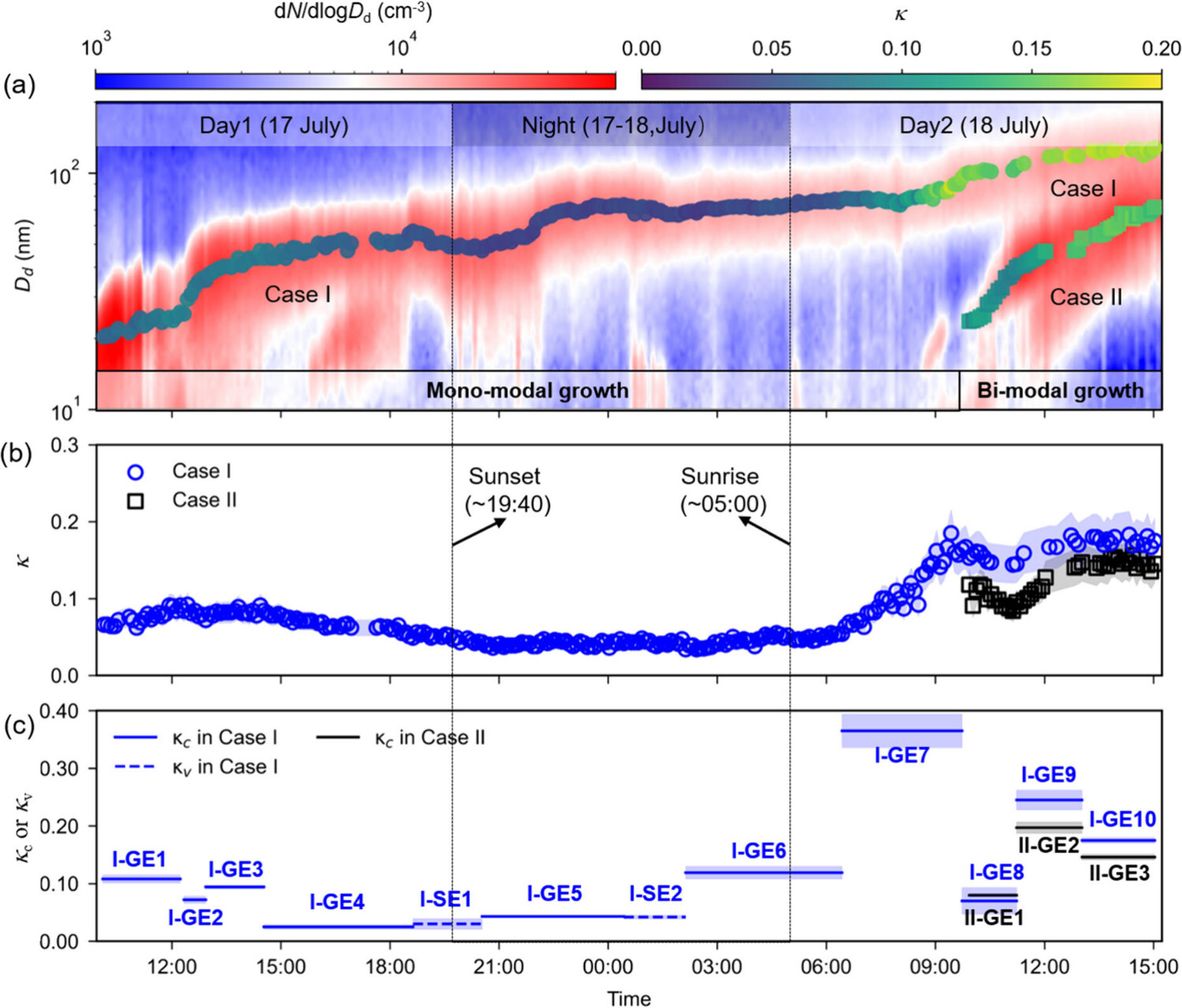
Figure 1. Exemplary condensational growth case captured by the system developed in this study, which occurred in Beijing on July 17 and 18, 2025. (a) Modal diameter, (b) k , and (c) kc or kv during the growth events. The “I-” and “II-” represents growth case I and II, while “GE” and “SE” represent growing episode x and shrinkage episode x, respectively. Shaded areas in (b) and (c) represent uncertainties of k and kc.
This research was published online on June 25 in Environmental Science & Technology, with the full-length article titled Characterizing Long-Term Multimodal Condensational Growth of Atmospheric Aerosols with the Synchronous Monitor of Aerosol Size and Hygroscopicity (SMASH). Xiong Chun, a postdoctoral researcher at the School of Environment, Tsinghua University, serves as the first author, while assistant professor Zheng Guangjie is the corresponding author. The collaborative author team includes academician He Kebin, professor Jiang Jingkun, associate professor Wang Dongbin and postdoctoral researcher Li Yuyang from School of Environment, Tsinghua University; professor Wang Zhibin from the College of Environmental and Resource Sciences, Zhejiang University; and Zhang Qiang from Beijing NaKe Environmental Technologies Co., Ltd.
This work was supported by Jing-Jin-Ji Regional Integrated Environmental Improvement-National Science and Technology Major Project (2025ZD1201100), the National Science Foundation of China (22476106, 22188102 and 42505076), and the China Postdoctoral Science Foundation (2025M780285).
Paper link:
https://doi.org/10.1021/acs.est.6c00847