The treatment, disposal, and high-value utilization of anaerobic digestion residue, commonly known as biogas residue, represent a key challenge in achieving sustainable organic waste management. Recently, the teams of Professor Liu Jianguo and Assistant Professor Deng Bing from Tsinghua University proposed a novel, solvent-free, two-step flash Joule heating (TS-FJH) process. This innovative method can efficiently convert biogas residue into high-quality graphene composite materials within an extremely short timeframe of just 1.4 seconds. The study demonstrates the unique advantage of in-situ utilization of metals within the residue to construct high-performance oxygen reduction catalysts. Simultaneously, it achieves a massive reduction of approximately 90% in life-cycle energy consumption and carbon emissions, alongside a significant cut in operating costs.
While the biogas industry is experiencing explosive growth as a critical carbon-negative pathway to replace fossil fuels, the rapid expansion of its infrastructure poses severe environmental and resource challenges due to the generation of massive amounts of residue. Derived primarily from livestock manure, straw, food waste, and sewage sludge, this residue is not only rich in pathogenic microorganisms and persistent organic pollutants but also carries potential heavy metal risks. Current disposal methods rely heavily on energy-intensive incineration or landfilling, which contribute to anthropogenic methane emissions and threaten groundwater safety. Meanwhile, the transition to carbon neutrality has driven demand for energy conversion technologies like fuel cells, which typically rely on expensive and scarce platinum catalysts. Since traditional synthesis of non-precious metal carbon materials involves complex, high-emission processes, existing end-of-pipe treatment models exacerbate secondary environmental risks and fail to fully exploit the resource value of waste biomass.
To address these issues, the researchers developed a feedstock-customized TS-FJH strategy that converts various sources of biogas residue into high-quality graphene composites without high-energy pretreatment. Based on flash Joule heating technology, the method first employs a low-temperature stage to rapidly pyrolyze insulating biomass precursors into conductive biochar, followed by a high-temperature stage utilizing pulse current to induce instantaneous graphene reconstruction. Specifically, cow manure residue, due to its endogenous iron-rich characteristics, allows for the in-situ anchoring of iron particles within a defect-rich graphene matrix during the electrothermal process, thereby creating an iron-graphene hybrid material with excellent oxygen reduction activity.
Benefiting from the extremely short reaction time and solvent-free nature of the process, Life Cycle Assessment and Techno-Economic Analysis indicate that this technology reduces energy consumption by over 88% and carbon emissions by over 89%, while cutting operating costs by 95% compared to traditional physical or chemical exfoliation methods. The process shows broad versatility, applicable to straw, sludge, and food waste residues, offering a fast, low-carbon, and economic path for agricultural waste upcycling.
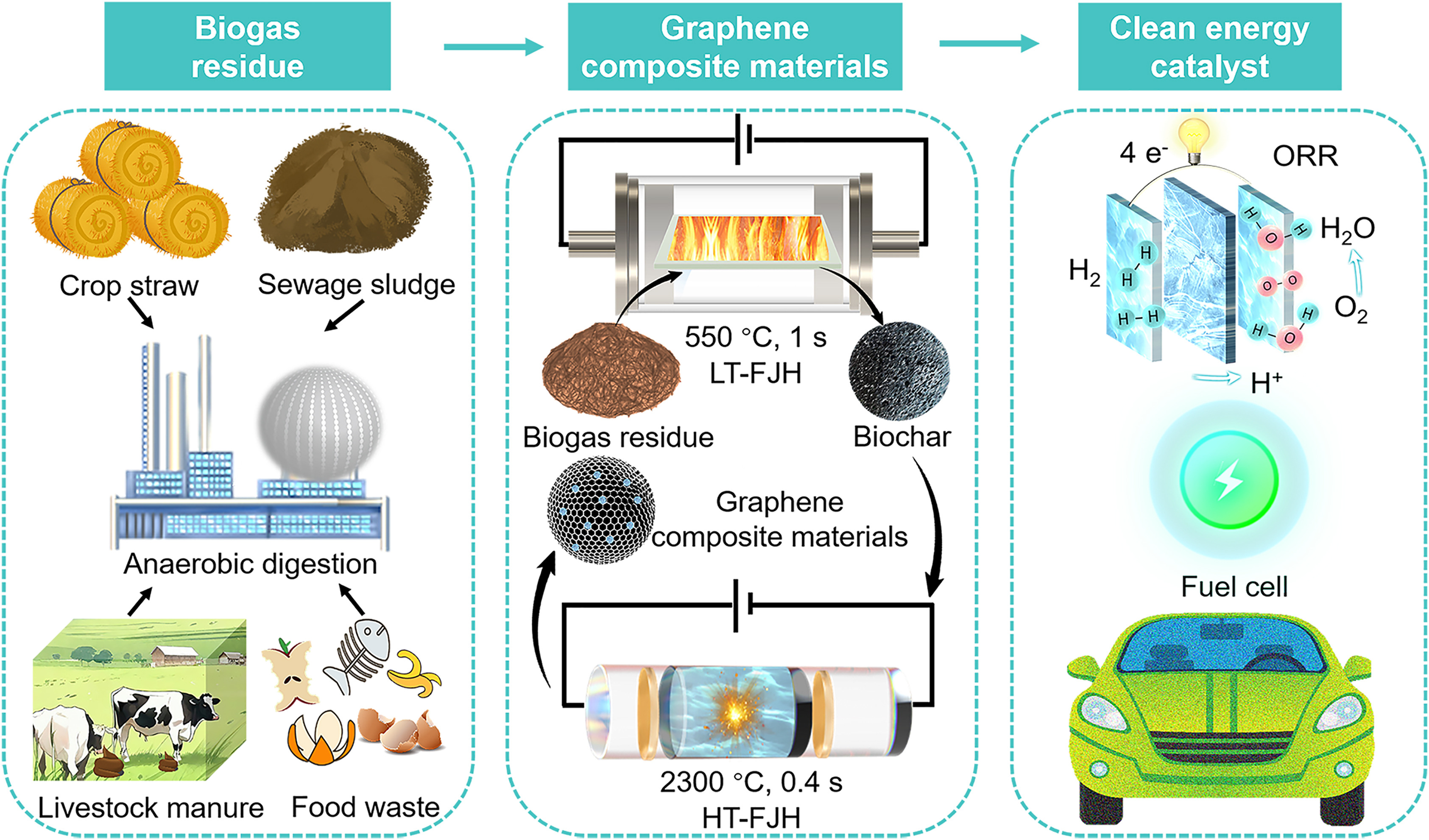
Sustainable upcycling of biogas residue into flash graphene composite materials for green electricity generation.
On January 16, 2026, these findings were published in the Cell Press journal One Earth under the title “Ultrafast flash Joule heating upcycles biogas residue into high-quality graphene composite materials for clean energy catalysis.” The corresponding authors are Professor Liu Jianguo and Assistant Professor Deng Bing from the School of Environment, with Ph.D. student Xu Mingyue as the first author.The paper's co-authors include Teng Wang, an undergraduate student (2022 cohort) at Tanwei College; Zhenyu Ren and Erkang Feng (2025 cohort PhD students), Jiaqiang Zhong (2023 cohort PhD student), Hao Bi (2024 cohort Master's student), Xingkun Xu (Postdoctoral Fellow) from the School of Environment; Ruili Zheng, a PhD student at the School of Metallurgy, Northeastern University; Lei Zhao from the West Coast New Area Branch of the Qingdao Ecology and Environment Bureau; and Guoyu Qian, an Associate Researcher at the Institute of Process Engineering, Chinese Academy of Sciences (CAS). This work was supported by the National Key R&D Program of China, the National Natural Science Foundation of China, and the Beijing Municipal Natural Science Foundation.
Paper Link: https://doi.org/10.1016/j.oneear.2025.101557