On November 7, the School of Environment (SOE) at Tsinghua University hosted the 784th Environmental Academic Salon and a high-level Global Environment Program (GEP) interactive TopTalk session. Dr. Jian Liu, former Director of the Science Division and Chief Scientist at the United Nations Environment Programme (UNEP), delivered a keynote speech titled “Science, Policy and Action Dynamics in Global Environment Management.” The event was moderated by Associate Professor Zhang Xiaoyuan, Assistant Dean of SOE.
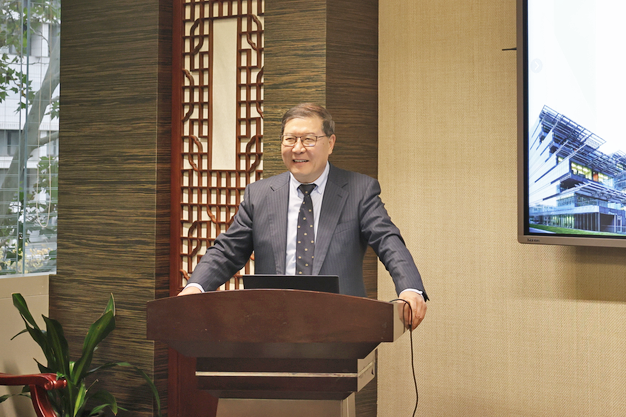
Liu Jian delivering his keynote speech.
Dr. Jian Liu opened the session by inviting students to analyze the “Triple Planetary Crisis”—climate change, biodiversity loss, and pollution. He pointed out that the root causes of these crises lie in unsustainable consumption and lifestyles, further tracing their origins back to the profound impact of technological developments from previous generations. Drawing on milestones from the publication of Silent Spring to the “Rio Conventions,” he illustrated the evolving feedback loops between scientific discovery, public awareness, and policy formulation. He captivated the students with a comparative analysis of global responses to ozone depletion versus climate change, emphasizing that the linear “science-to-policy” model is no longer sufficient. Instead, he proposed a triangular dynamic where science, policy, and direct action must interact simultaneously to achieve sustainability.
During the interactive Q&A, Dr. Liu engaged in a candid dialogue with students on international cooperation and the “double-edged sword” of technological innovation.
Regarding global collaboration, he noted that despite geopolitical shifts, major economies like China and the EU remain committed to climate action. This stems from the shared consensus that “humanity has only one Earth”—protecting the ecological environment is a matter of common interest for all nations. Students also raised questions about the ethics of innovation. Dr. Liu advised the young researchers to treat technology as a “double-edged sword,” reminding them to evaluate not just technical potential, but also economic feasibility, social acceptance, and potential ecological risks before advocating for new solutions. On the topic of science-policy translation, he suggested a “dual-track approach”: raising public awareness through science communication while establishing direct, evidence-based advisory mechanisms for decision-makers.
Dr. Jian Liu brings nearly 40 years of international leadership to the table. His distinguished career includes serving as the Executive Secretary of the IPCC and Chief Scientist of UNEP. He has been a pivotal figure in advancing science-policy-business collaborations and has initiated numerous global dialogues to address ecosystem management and climate adaptation.
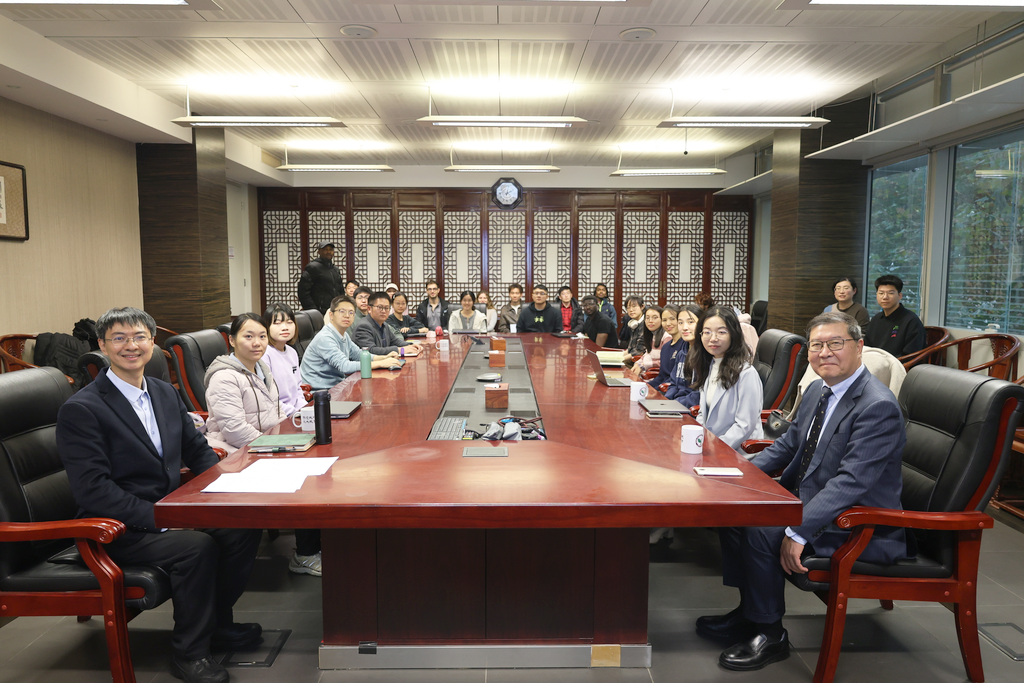
Group photo of the attendees and guest speaker.
The session concluded with a resonant message to the students: to become effective global environmental leaders, they must learn to navigate the integration of rigorous science with pragmatic policy and bold action. Students expressed that the TopTalk provided them with a systemic and forward-looking roadmap for their future careers in global governance.