On December 5, 2025, Erik Solheim, Co-Chair of the Europe-Asia Center and former Under-Secretary-General of the United Nations and Executive Director of the UN Environment Programme (UNEP), attended the 133rd Tsinghua Environmental Forum and Top Talk event. He delivered a keynote speech titled “Global Green Transition and China: Working Together to Create a New Future for Climate Cooperation.” The event was co-hosted by the School of Environment and Xiuzhong College, organized by the Global Environmental Program (GEP), and supported by various international organizations and partners. The session was moderated by Zhang Xiaoyuan, Assistant Dean of the School of Environment, and attended by nearly 100 students and faculty members.
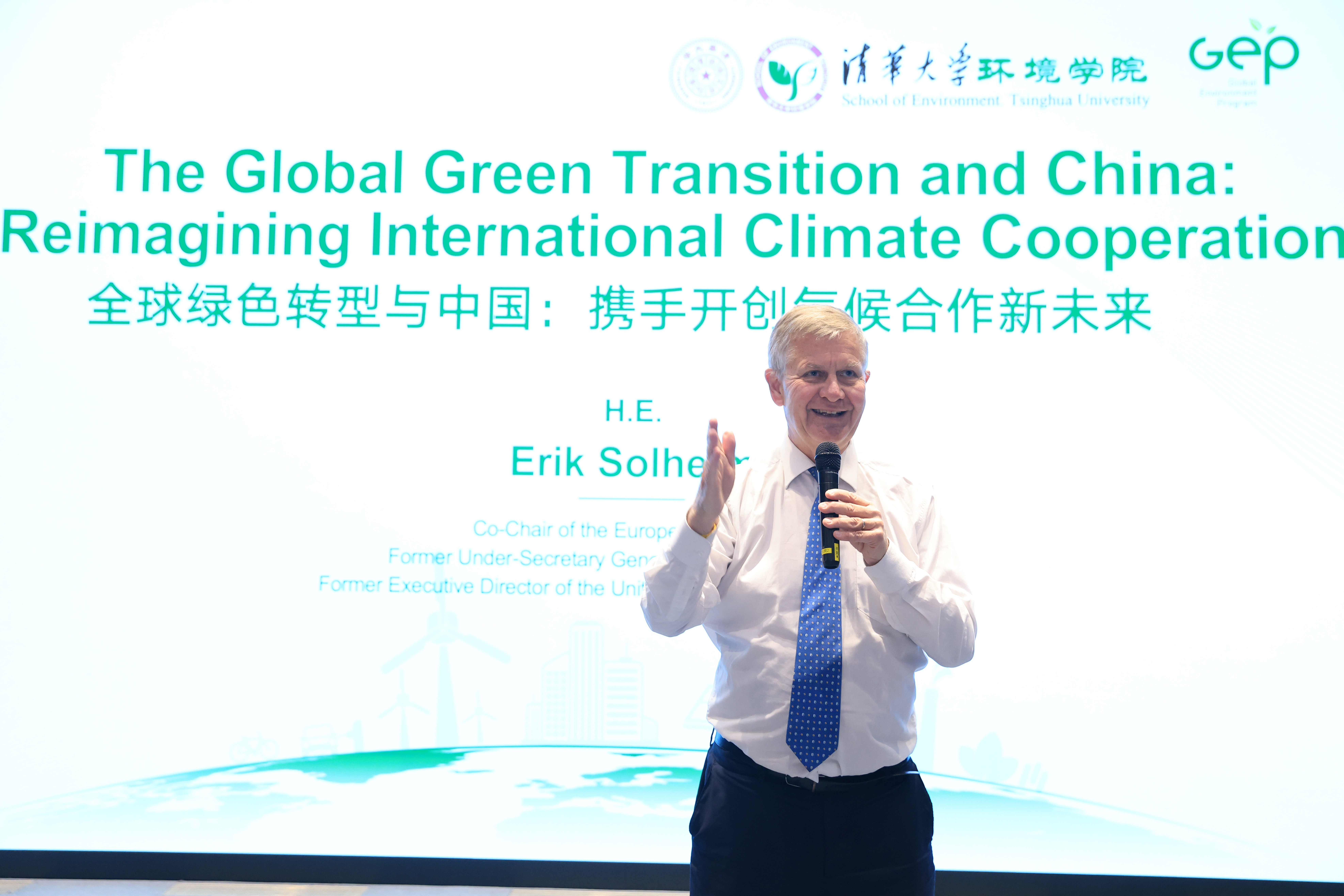
Erik Solheim delivering his keynote speech.
During his speech, Solheim reviewed the historical trajectory of China’s green development since the Reform and Opening-up. He noted that China has evolved from a focus on economic growth to embracing the philosophy that “Clear waters and green mountains are just as valuable as gold and silver,” and is now leading with “new quality productive forces” characterized by renewable energy and artificial intelligence. Using case studies such as Beijing’s air quality improvement, watershed restoration in Zhejiang, desertification control and photovoltaic projects in Western China, and the establishment of the national park system, he illustrated the remarkable speed and scale of China’s transformation. He emphasized that China’s leadership in photovoltaics, electric vehicles, and power batteries has provided the world with significant cost advantages and development opportunities.
Regarding the global implications of China’s experience, Solheim identified several key drivers of China’s breakthroughs in renewable energy and ecological protection: advanced development philosophies, strategic political determination, efficient synergy between the government and the market, and the technological spillover effects generated by a massive domestic market.
On the subject of international cooperation, Solheim pointed out that the future global order will be multipolar, with China playing a vital role in driving global green investment, reforming governance systems, and promoting regional stability. He remarked that even if participation in the climate agenda fluctuates in some regions, China and the developing world can continue to jointly advance green standards, clean energy deployment, and climate governance cooperation.
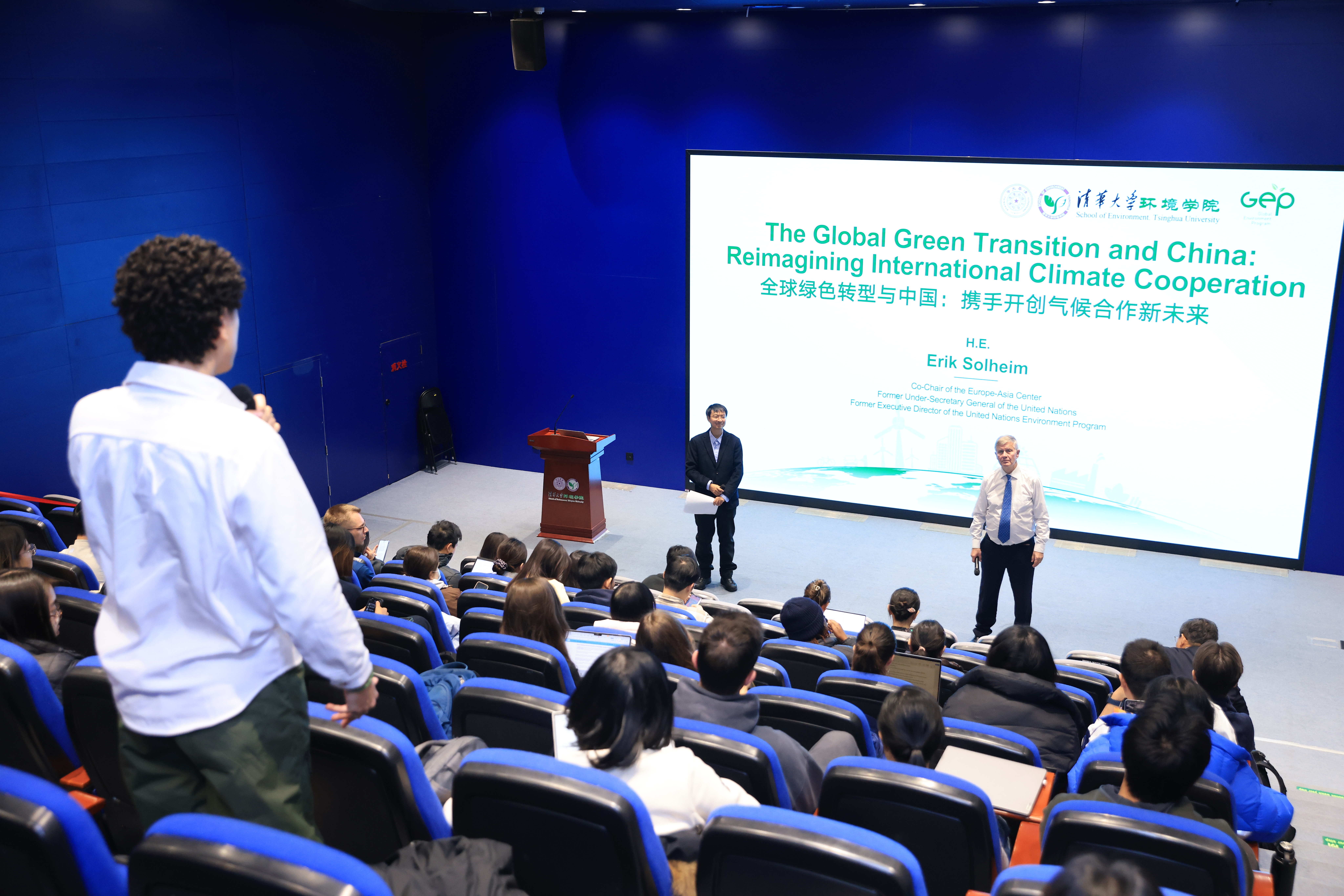
The Q&A session
In the interactive segment, students engaged in a deep discussion with Solheim on topics ranging from youth climate action and the circular economy to the green transition of the Global South and the concept of a “just transition.” Solheim encouraged the students to contribute to green governance through personal lifestyle changes, technological innovation, and public advocacy. This event provided Tsinghua students with a high-level platform for direct exchange with a global leader in environmental governance, offering fresh perspectives on the active role youth can play in the global green transition.

Group photo of the attendees and guest speaker.