On the morning of July 3, the 14th World Peace Forum, co-hosted by Tsinghua University and the Chinese People’s Institute of Foreign Affairs, opened at Tsinghua University’s Main Building. Chinese Vice President Han Zheng attended and addressed the opening ceremony.
Under the theme “Global Governance and International Security Cooperation: Integrity, Innovation, and Inclusiveness,” the opening ceremony was attended by about 400 participants, including renowned strategists, think tank leaders, diplomatic envoys to China, and scholars from China and abroad. Wu Ken, President of the Chinese People’s Institute of Foreign Affairs; Ren Youqun, Vice Minister of Education; and Qiu Yong, Secretary of the CPC Tsinghua University Committee, attended the opening ceremony. Li Luming, President of Tsinghua University and Chairman of the World Peace Forum, delivered a welcome speech, and Yang Bin, Vice Chancellor of Tsinghua University Council and Secretary-General of the World Peace Forum, presided over the ceremony. Other attendees included Cai Wei, Assistant Foreign Minister; Luo Zhaohui, former Chairman of the China International Development Cooperation Agency; and Ai Ping, Vice-President of the Chinese Association for International Understanding.

Chinese Vice President Han Zheng attends and addresses the opening ceremony of the 14th World Peace Forum at Tsinghua University. Photo by Ding Lin/Xinhua
China will take the World Artificial Intelligence (AI) Conference and High-Level Meeting on Global AI Governance as an opportunity to strengthen exchanges and cooperation with all parties to build a global AI governance system based on broad consensus, Chinese Vice President Han Zheng said on Friday.
Han made the remarks when addressing the opening ceremony of the 14th World Peace Forum in Beijing, calling for strengthening governance in emerging fields like AI.
China has put forward the Global AI Governance Initiative, advocating a people-centered approach and the development of AI for the good of humanity, Han said.
The world is undergoing accelerated transformation unseen in a century, with growing instability and turbulence, frequent geopolitical conflicts, and more prominent risks and governance deficits, Han noted.
Chinese President Xi Jinping has put forward the Global Governance Initiative to promote the building of a more just and equitable global governance system, injecting much-needed stability and positive energy into the world, he said.
Han added that China has always taken concrete actions to uphold the central role of the United Nations in international affairs and faithfully fulfilled its duties and missions as a permanent member of the Security Council. He expressed China's willingness to work with all countries to maintain the post-war international order and uphold international fairness and justice.
As the host of the 33rd APEC Economic Leaders' Meeting, China will work with all partners in building an Asia-Pacific community, Han said.
China will continue to expand high-standard opening up and work with all countries to promote a universally beneficial and inclusive economic globalization, he stated.
Li Luming said that, as China’s first high-level non-governmental international security forum, the World Peace Forum has always upheld the principles of openness, inclusiveness, pragmatism, professionalism and innovation, and has carried out in-depth dialogue and discussion on key issues and major strategies in the field of international security.
Universities are important bridges for exchanges and mutual learning among civilizations and play an irreplaceable role in strengthening people-to-people bonds. Tsinghua University has long been committed to cultivating outstanding talent with global competence, producing innovative achievements with global impact, advancing high-level opening-up, further implementing its global strategy, expanding its international exchange network, promoting in-depth exchanges between Chinese and international faculty and students, and building multilateral cooperation platforms. Through these efforts, Tsinghua has sought to contribute the wisdom and expertise of universities to jointly address global challenges and promote the well-being of all humanity.
Li said that as global governance has reached a new crossroads, it is important to stay committed to the right direction, pursue innovation in governance, and ensure that the outcomes of cooperation are shared. He expressed hope that the guests would engage in candid exchanges, deepen mutual understanding and strengthen cooperation, so as to seek consensus that brings certainty to a world marked by turbulence and change, contribute new ideas and proposals to improving the global governance system, and gather strong momentum for building a community with a shared future for mankind.
Mushahid Hussain Sayed, former Chairman of the Senate Foreign Relations Committee of Pakistan and former Chairman of the Senate Defence Committee of Pakistan, said that world history has entered a new chapter and that the global governance system is showing a positive trend of development. He said countries should remain optimistic and work together to shape a more peaceful and prosperous future.
Kim Sung-Hwan, former Minister of Foreign Affairs and Trade of the Republic of Korea, said history shows that the more unstable the situation becomes, the greater the need for dialogue. Peace is never achieved overnight, he said, adding that countries should make sustained efforts to strengthen exchanges and mutual trust, and deepen dialogue and cooperation.
In the first plenary session held in the morning, themed “Rebuilding Peace in the Middle East,” Yan Xuetong, Honorary President of the Institute of International Relations at Tsinghua University, moderated a dialogue with Hina Rabbani Khar, former Minister of Foreign Affairs of Pakistan; Abdel Elah Al Khatib, former Minister of Foreign Affairs of Jordan; and Gareth Evans, former Minister for Foreign Affairs of Australia.
Khar shared Pakistan’s efforts to help maintain regional peace and stability and promote peaceful coexistence between regions, and said that conflicts should be resolved through dialogue and consultation. Al Khatib said the question of Palestine lies at the heart of Middle East issues, adding that most countries in the international community view the war as a war of choice rather than a war of necessity. Evans said national security concerns cannot be resolved through killing and hopes that a solution could be reached through diplomacy and cooperation.
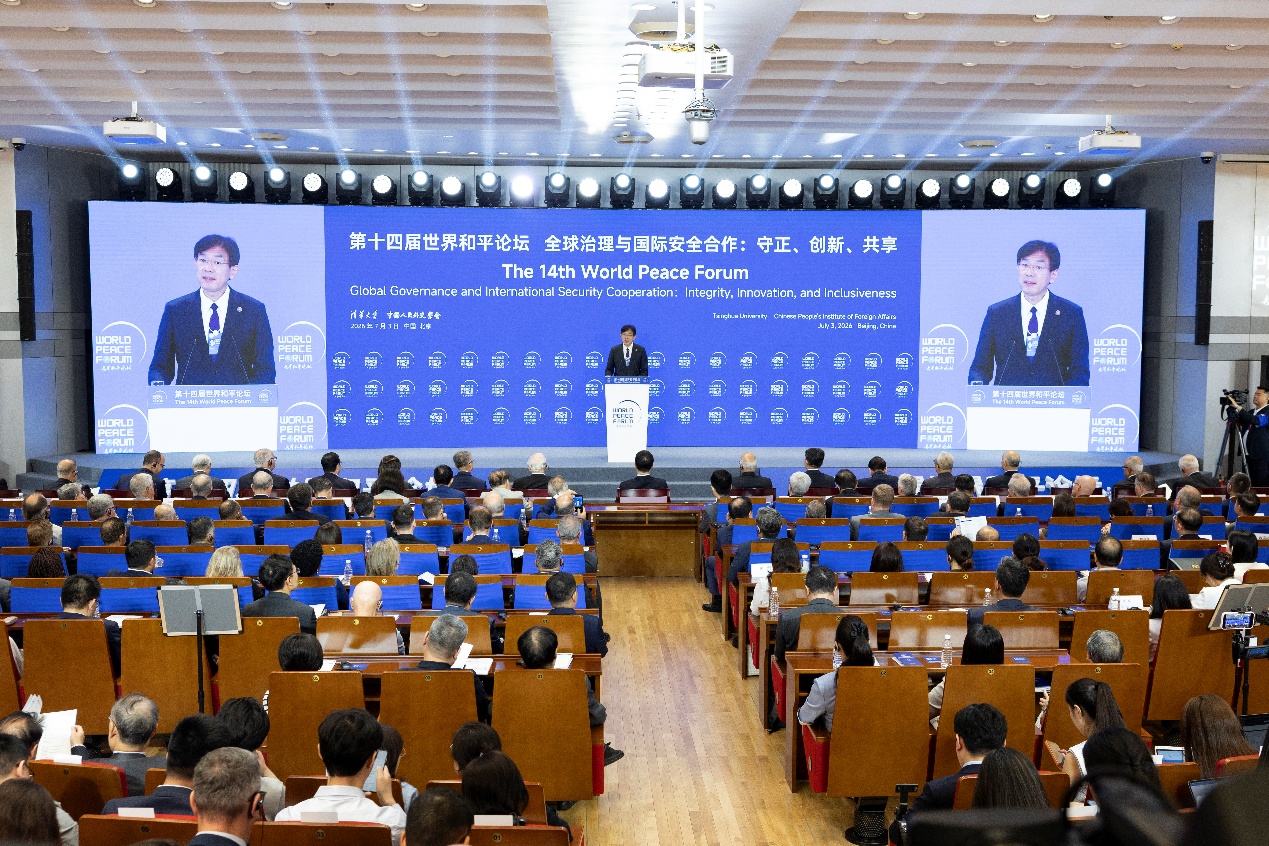
The three-day forum features four plenary sessions, one lunch dialogue and 21 panel discussions. The plenary sessions focus on themes including “Rebuilding Peace in the Middle East,” “Major-Power Relations and World Peace,” “Global South and Reform of Global Governance” and “Regional Conflicts and Security Architecture Innovation.” Participants are engaging in in-depth exchanges on major issues related to global governance and international security cooperation, exploring ways to stay committed to the right direction, improve the global governance system, deepen international security cooperation, jointly respond to global challenges, and promote world peace and common development.
Writer: Gillian Tang
Source: Xinhua, editors: Li Han, John Paul Grima