Tsinghua University held a conference on the development of foreign languages and literatures in the new century on September 19. Qiu Yong, secretary of the CPC Tsinghua University Committee; Ning Qi, deputy secretary of the Party Committee and vice president of Peking University; and Professor Li Li, pro-vice-chancellor, global at Newcastle University, attended the conference and delivered remarks. Peng Gang, vice president of Tsinghua University, and Li Yiqun, assistant to the president of Beijing Foreign Studies University, also attended the conference.
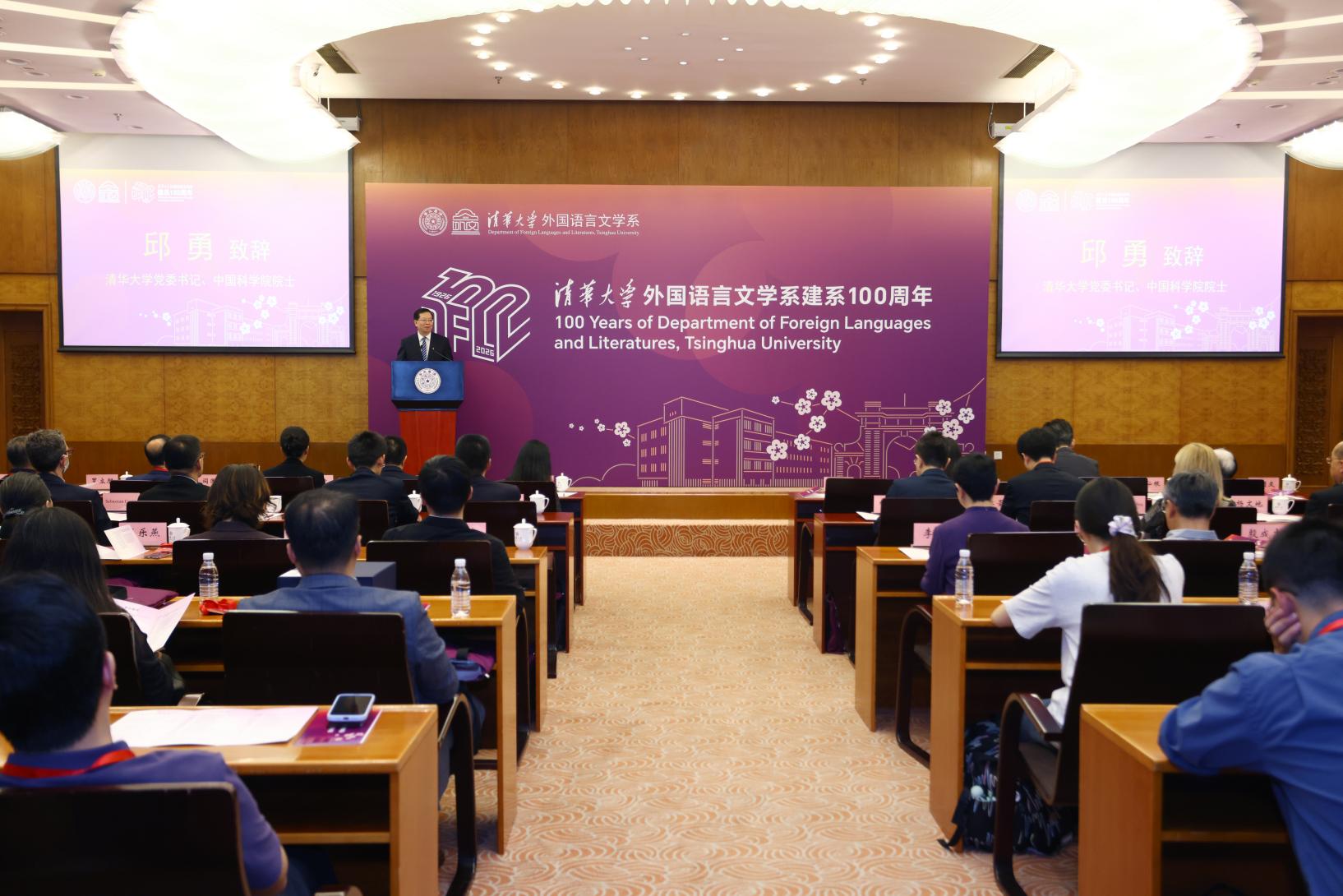
Venue of the conference
Qiu Yong extended a warm welcome, on behalf of the University, to the guests attending the conference and offered his sincere congratulations to all faculty, staff, students, and alumni of the Department of Foreign Languages and Literatures (DFLL). He noted that Tsinghua’s discipline of foreign languages and literatures has a long history. As early as its founding in 1911, the University already offered courses in English, German, French, and Latin. In 1926, the Department of Western Literatures was established as one of the University’s first 17 departments.
Looking back over the past century, from Tsinghua to National South-West Associated University, the Department advanced scholarship through the integration of Chinese and Western learning and served the nation during the War of Resistance against Japanese Aggression. The example set by distinguished scholars and their commitment to the country were mutually reinforcing, giving rise to academic traditions of liberal education and integrating Chinese and Western learning, as well as a patriotic tradition of devotion to the country and perseverance in the face of hardship. From the difficult years of preserving the discipline after the department was dissolved to the reform and development following its restoration, the Department has consistently regarded serving the country and cultivating talent as its mission. It has preserved a century-old humanistic legacy, strengthened the foundation for university-wide foreign language instruction, and continuously advanced professional education and discipline development. Since the beginning of the new era, the Department has upheld its traditions while pursuing innovation. Its academic fields have continued to expand, and the quality of talent cultivation has steadily improved. It has gradually developed into a major center for foreign-language scholarship and talent cultivation, rooted in China, oriented toward the world, and committed to serving dialogue among civilizations.
Qiu Yong emphasized that the century-long history of foreign languages and literatures at Tsinghua has resonated with the rejuvenation of the Chinese nation and has been closely bound up with the nation’s destiny. It has been a century of upholding liberal education, advancing scholarship through the sustained integration of Chinese and Western learning, and shouldering the mission of the times. Generation after generation of faculty and students of the Department have carried the torch forward and worked tirelessly, writing a distinctive Tsinghua chapter in the development of foreign-language disciplines in China.
Standing at the starting point of its second century, Qiu Yong called on the DFLL to uphold the fundamental task of fostering virtue and cultivating people, and to nurture well-rounded professionals with a commitment to the country, a global outlook, and strong professional capabilities. He called for advancing interdisciplinary integration and exploring more deeply the connections among language, cognition, culture, and artificial intelligence, continuously strengthening the discipline’s capacity for independent innovation, and developing more original concepts and theories with Tsinghua characteristics. He also called for deepening international exchanges and cooperation to serve national strategies and high-standard opening-up, remaining rooted in China and at the forefront of the times, making China’s voice heard on the world stage and contributing greater Tsinghua wisdom to people-to-people exchanges between China and other countries and to the progress of human civilization.
Ning Qi said that the DFLL at Tsinghua has consistently integrated its own development into the destiny of the country, the future of the Chinese nation, and the needs of the times. In recent years, guided by its development vision for its second century, the DFLL has made comprehensive progress in such areas as discipline development, talent cultivation, research innovation, and international cooperation. Peking University stands ready to continue working hand in hand with Tsinghua University to advance foreign language education in China and foster innovation in the independent knowledge system of foreign languages and literatures, contributing greater wisdom and strength to serving national strategies, deepening exchanges and mutual learning among civilizations, and helping build a new form of human civilization.
Li Li said that over the past century, the DFLL at Tsinghua has passed down its legacy from generation to generation, gathered distinguished scholars, and nurtured outstanding students, establishing a benchmark for the discipline of foreign languages and literatures in China. Newcastle University and the DFLL at Tsinghua share deep academic ties spanning more than a century. The two universities look forward to further deepening China-UK higher education cooperation in the humanities, focusing on areas of shared strength to jointly develop benchmark projects in China-UK humanities cooperation and build an international academic community based on equality and mutual learning.
Wu Xia, dean of the DFLL, reviewed the century-long evolution of the discipline of foreign languages and literatures at Tsinghua. She said that the Department’s century-long evolution not only bears witness to the way generations of scholars in the Department who have integrated their academic ideals into the broader strategic landscape of the nation, but also reflects the broader trajectory of the foreign-language discipline as it evolved alongside China’s modernization. At this new starting point following the centenary of the Department’s establishment, Tsinghua’s foreign languages and literatures discipline will carry forward its century-old tradition, remain firmly committed to its core mission of serving national strategies, and cultivate foreign-language professionals with both a strong commitment to the country and a global outlook, contributing to the advancement of Chinese modernization and the building of a community with a shared future for humanity.
Gao Yang, associate dean of the DFLL, spoke as a faculty representative, followed by Wu Shuyao, an undergraduate student who enrolled in 2023, who spoke as a student representative. The conference was chaired by Zhang Yining, associate dean of the DFLL. Attendees watched a video commemorating the Department’s 100th anniversary, along with a video featuring messages of congratulations.
More than 160 participants attended the conference, including heads of schools of foreign languages from nearly 30 peer universities in China, such as Peking University, Renmin University of China, Nankai University, Fudan University, Shanghai Jiao Tong University, Shanghai International Studies University, Nanjing University, Zhejiang University, Wuhan University, and Huazhong University of Science and Technology; alumni representatives; retired and current leaders, faculty and staff, and student representatives of the DFLL; and heads of relevant schools, departments, and administrative offices at Tsinghua. A series of activities were also held alongside the conference, including the Forum on the Development of the Discipline of Foreign Languages and Literatures and the Construction of the Independent Knowledge System, as well as the DFLL Alumni Development Forum.
Editors: Li Han, John Paul Grima