
As artificial intelligence models continue to grow in scale, computing systems are required not only to process larger networks but also to handle multiple tasks on a single platform. With its advantages of high bandwidth, low energy consumption, and intrinsic parallelism, optical computing provides a new route to overcoming the energy-efficiency and bandwidth bottlenecks of conventional electronic computing. However, most existing optical neural networks rely on increasing network depth to improve performance and are therefore constrained by factors including the linearity of optical structures, device-control complexity, transmission loss, and error accumulation. For multi-task processing, different tasks often require independent hardware or the reconfiguration of optical weights. Recently, a research team led by Hongwei Chen from the Department of Electronic Engineering at Tsinghua University proposed an on-chip photonic mixture-of-experts architecture, PMoE (Photonic Mixture-of-Experts). By introducing the mixture-of-experts concept into integrated optical computing, this work provides a new approach to scalable, multi-task on-chip optical neural networks.
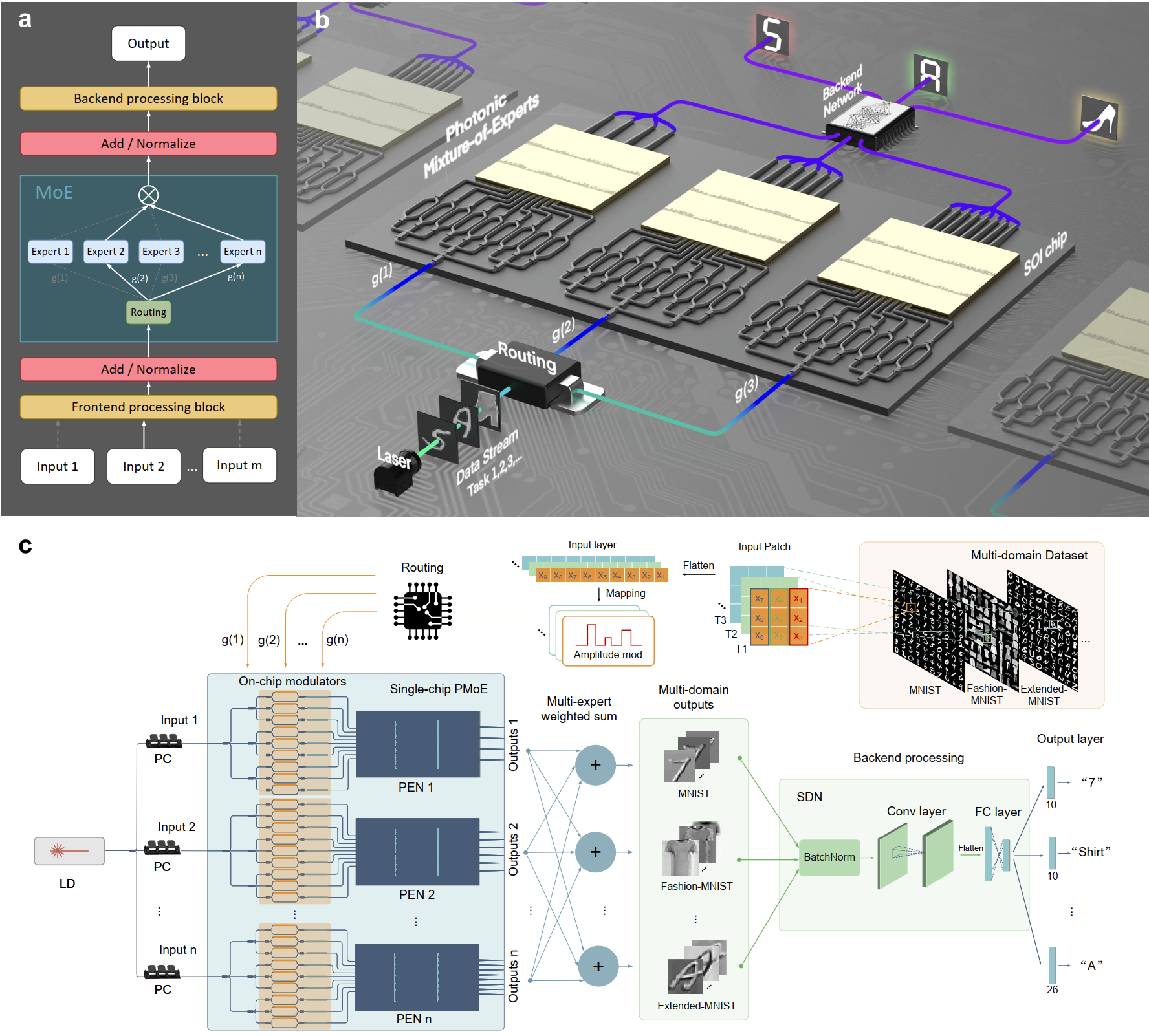
PMoE concept, on-chip architecture, and data-processing workflow
The core concept of PMoE is to enable multiple photonic experts to work collaboratively and to scale the network parameters. The front end of the system consists of multiple parallel, passive diffractive photonic expert networks. Lightweight routing weights determine which experts receive the input signals and how the outputs of different experts are combined through weighted aggregation. A unified shared digital network subsequently performs further processing of the optical features. By decoupling dynamic routing from static optical feature extraction, the system does not need to modify its physical optical weights during operation. Tasks can be switched simply by adjusting the input routing, thereby avoiding the need to configure a separate optical processor for each task.
The research team conducted multi-task experiments using the MNIST, Fashion-MNIST, and Extended-MNIST datasets. The sparse PMoE employing hard routing achieved an average classification accuracy of 94.8%, significantly outperforming conventional optical and digital convolutional neural-network baselines. With weighted routing, the dense PMoE enabled multiple photonic experts to work collaboratively, further improving the average accuracy to 97.1%. Compared with deploying separate optical neural networks for different tasks, PMoE improved classification accuracy while reducing the number of digital backend parameters by approximately 67%. The experimental results also demonstrated the advantages and application potential of scaling optical neural-network parameters along the network “width.”
The research team fabricated a monolithically integrated PMoE chip on a silicon-on-insulator platform. Within a computational-core area of only 0.067 mm², the chip integrates three photonic expert networks and 18 parallel optical convolution kernels. With high-speed electro-optic modulation operating at 10 GHz, the chip can achieve a computing throughput of 3.06 TOPS and a computational density of 45.7 TOPS/mm² within the computing core. By incorporating technologies such as sparse task-routing scheduling, tunable optical power splitters, and efficient optical switching arrays, the number of experts and computing capacity of PMoE can be further increased.
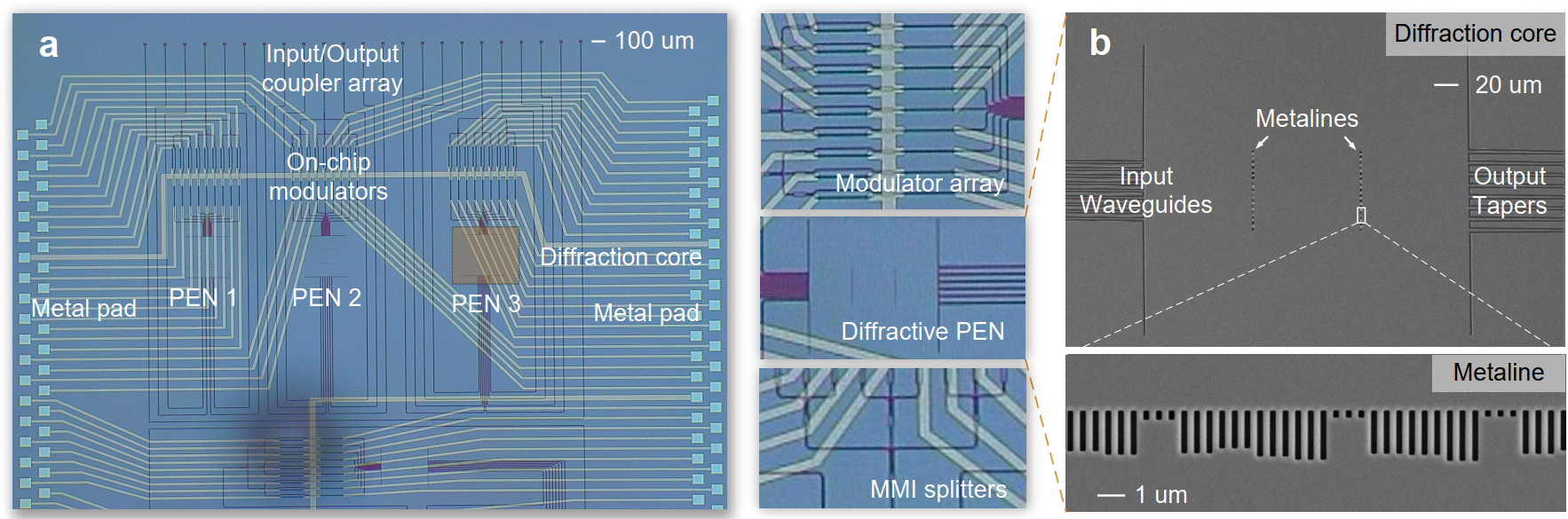
PMoE chip, diffractive computing cores, and devices
On June 3, 2026, the research results were published online in Nature Communications under the title “Photonic Mixture-of-Experts for scalable multi-task on-chip optical neural networks.” Wencan Liu, a doctoral student enrolled in 2023 in the Department of Electronic Engineering at Tsinghua University, is the first author. Professor Hongwei Chen, Yuyao Huang, who received his doctoral degree in 2025, and Associate Professor Tingzhao Fu from the National University of Defense Technology are the corresponding authors. This research was supported by the National Key Research and Development Program of China, the National Natural Science Foundation of China, and other research programs.
Paper link: https://www.nature.com/articles/s41467-026-73983-4
Editors: Li Han, John Paul Grima