The Sixth Global Forum on the Development of Computer Science was held in Shanghai on the morning of July 17 as a hybrid event. Professor Wu Huaqiang, vice president of Tsinghua University, attended the forum and delivered remarks. The forum was co-chaired by Professor Dame Wendy Hall, former president of the Association for Computing Machinery (ACM) and associate vice president of the University of Southampton, and Professor Wu Jianping, academician of the Chinese Academy of Engineering and professor in Tsinghua University’s Department of Computer Science and Technology.
Under the theme “The New Mission of the Computer Science,” the forum brought together leading scholars and heads of computer science schools and departments from dozens of universities. Participants included Professor Tan Tieniu, academician of the Chinese Academy of Sciences and chair of Nanjing University CPC Council; Professor Miao Chunyan, associate vice president of Nanyang Technological University; Professor Aad van Moorsel, head of the School of Computer Science at the University of Birmingham; Professor Peter Stone, chair of the Department of Computer Science at the University of Texas at Austin; Professor Nancy M. Amato, director of the Siebel School of Computing and Data Science at the University of Illinois Urbana-Champaign; and Professor Xiaofang Zhou, head of the Department of Computer Science and Engineering at the Hong Kong University of Science and Technology. Representatives from Fudan University, Zhejiang University and other universities also attended. The participants explored new approaches to advancing the high-quality development of computer science amid the challenges of a new era. The forum was moderated by Professor Yin Xia, dean of Department of Computer Science and Technology of Tsinghua University.
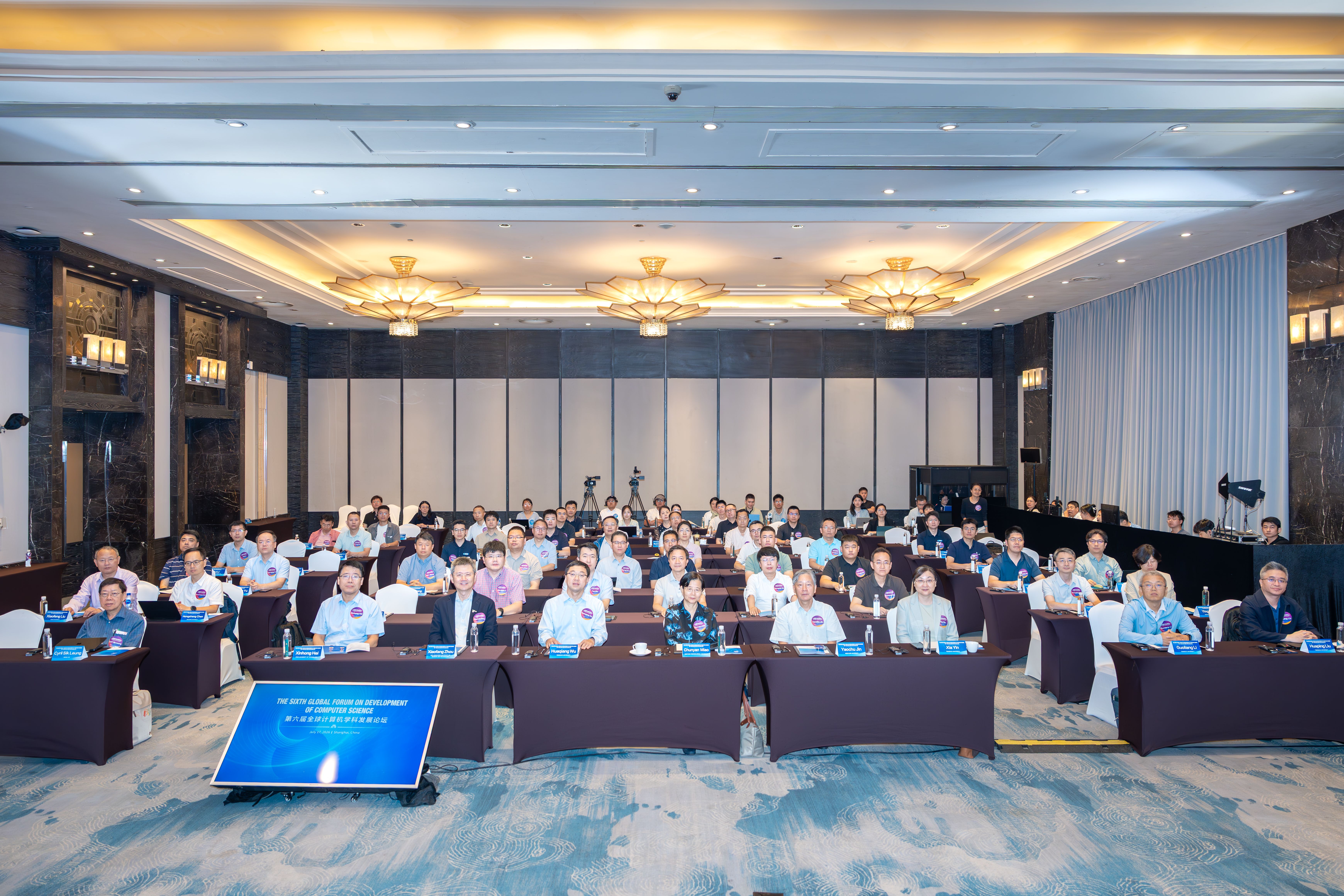
Group photo of forum participants
In his welcome address, Professor Wu Huaqiang noted that educational paradigms suited to the age of artificial intelligence are still being explored. Concrete and feasible approaches are urgently needed to harness AI’s potential in teaching, scientific research and talent development, he said. Professor Wu expressed the hope that the forum would provide a platform for scholars to build consensus and lay a solid foundation for the future development of the discipline.
Professor Dame Wendy Hall reviewed the 70-year evolution of artificial intelligence from a theoretical concept to a transformative technology. She stressed that advances in AI must be aligned with ethical standards and social responsibility so that the technology can genuinely benefit all humanity.
During the keynote session, Professors Peter Stone, Nancy M. Amato and Xiaofang Zhou shared their universities’ experiences and practices in AI education.
The panel discussion focused on “Global Collaboration and Higher Education in Computer Science in the Age of AI.” Professors Tan Tieniu, Miao Chunyan, Aad van Moorsel, Peter Stone, Nancy M. Amato, and Xiaofang Zhou exchanged views on reforming evaluation systems, redefining the core values of the discipline, restructuring academic departments, developing new models of university-industry-research collaboration, and maintaining international cooperation amid geopolitical challenges. The speakers emphasized the importance of upholding the spirit of open science and strengthening collaboration across disciplines and industries.
The Global Forum on the Development of Computer Science is a high-level international academic forum hosted by Tsinghua University. It brings together leaders of computer science schools and departments at the world’s leading universities to advance the discipline globally. This year’s forum highlighted that universities need to redefine computer science education and research paradigms in response to the AI revolution. Forum participants stressed the importance of boosting the discipline’s impact through flexible organizational structures and deeper collaboration among universities, industry and research institutions.
Editors: Li Han, John Paul Grima