Recently, a research team led by Professor Bing Zhu from the Department of Chemical Engineering and the Institute for Circular Economy at Tsinghua University made significant progress in quantifying China's rubber socioeconomic metabolism. For the first time, the research systematically quantifies the material flows and stocks of rubber across its full lifecycle in China from 1978 to 2022, providing a scientific model and foundational data for understanding the country's rubber metabolism and promoting sustainable consumption and production of rubber materials.
Rubber is an essential polymer material in modern society, widely used for its unique elasticity. Among various rubber products, tires have long been the primary focus of both socioeconomic metabolism research and circular economy practices, owing to their high demand, concentrated applications, and ease of identification and collection at the end of their lifespan. However, with socioeconomic development and improved living standards, non-tire rubber products (e.g., vibration dampers, medical devices, seals, and footwear) have become increasingly important and show great potential in emerging fields such as embodied AI and flexible electronics. Compared with tires, non-tire rubber products are far more diverse in type, formulation, and service life, and differ significantly in their production, use, disposal, and recycling stages. A complete and accurate understanding of rubber's socioeconomic metabolism thus requires integrating both tire and non-tire products and systematically mapping their material flows and stocks – an area that had remained largely unexplored.
To address this gap, the study expands the scope beyond traditional rubber industry statistics to include silicone rubber, polyurethane rubber, and thermoplastic polyurethane, materials widely used in non-tire applications. A dynamic material flow model was developed, covering polymer production (12 types of virgin rubber), manufacturing (seven product types and associated compounding ingredients), use (8 sectors and the release of micro-rubber particles), waste disposal (seven end-of-life pathways), and trade.
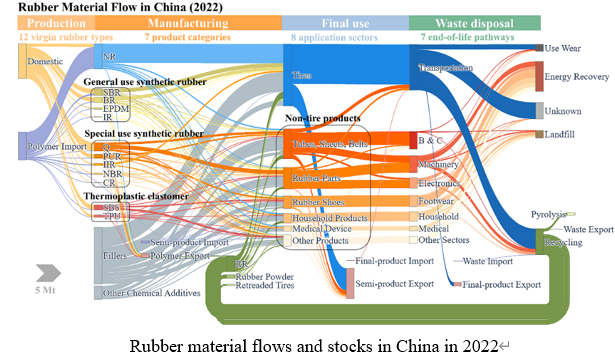
Rubber material flows and stocks in China in 2022
Results show that by 2022, annual consumption of non-tire products reached 22.5 Mt, accounting for 67% of total consumption and surpassing that of tires. This structural shift reflects the transformation of China's rubber industry from meeting basic transportation demand (tires) toward supporting industrial upgrading and diversified household consumption. In-use rubber stocks in non-transportation sectors accumulated to 156.2 Mt (89% of the national total), indicating substantial future waste streams. Yet only 27% of recycled rubber came from non-tire products, reflecting barriers in collection, sorting, and processing. These results demonstrate the growing significance of non-tire uses and underscore the need for upstream material innovation, clearer classification and statistics, and downstream sector-specific waste management to close rubber loops and reduce environmental pressures.
The study, entitled "Beyond Tires: 45 Years of Rubber Flows and Stocks in China (1978–2022)," was published on January 14 in Environmental Science & Technology. The paper’s co-first authors are Chunlong Li (M.S. student), Yuheng Cao (Ph.D. student), and Yucheng Ren (Ph.D. graduate class of 2025), all from the Department of Chemical Engineering, Tsinghua University. Professor Bing Zhu is the corresponding author. Contributing authors from Tsinghua include Associate Professor Dingjiang Chen and Professor Baohua Guo at the Department of Chemical Engineering, Professor Ming Xu at School of Environment, and Ph.D. students Hengzhi Zhu, Zheng Zhou, and M.S. student Zhuolun Du. External collaborators include Professor Ming Tian from the College of Materials Science and Engineering, Beijing University of Chemical Technology, and Dr. Meng Jiang from the Department of Energy and Process Engineering, Norwegian University of Science and Technology.
This work follows the group's previous studies on the full-chain material flows and stocks of commodity plastics, non-commodity plastics, and textile fibers in China. Together, these studies constitute a systematic quantification of the socioeconomic metabolism of the country's three major polymer material categories: plastics, fibers, and rubbers.
The research was supported by the Tsinghua-Sinopec Joint Institute for Green Chemical Industry Supporting Project and the State Key Laboratory of Chemical Engineering and Low-carbon Technology. Valuable expert consultations were provided by specialists from the China Petroleum and Chemical Industry Federation, the China Rubber Industry Association, and the China Synthetic Rubber Industry Association.
Link to paper: https://doi.org/10.1021/acs.est.5c12736
Editor: Li Han