During the IEEE Global Communications Conference 2025, the IEEE Communications Society (ComSoc) presented its annual awards. A research team from the Department of Electronic Engineering at Tsinghua University was awarded the 2025 IEEE ComSoc Stephen O. Rice Prize. The winning paper, “Channel estimation for extremely large-scale MIMO: Far-Field or near-field?”, was authored by Mingyao Cui, a master’s student enrolled in 2020, and his supervisor, Prof. Linglong Dai. Published in IEEE Transactions on Communications (IEEE TCOM) in April 2022, this work marks the first time in the award’s 50-year history that Tsinghua University has been honored as the lead institution.
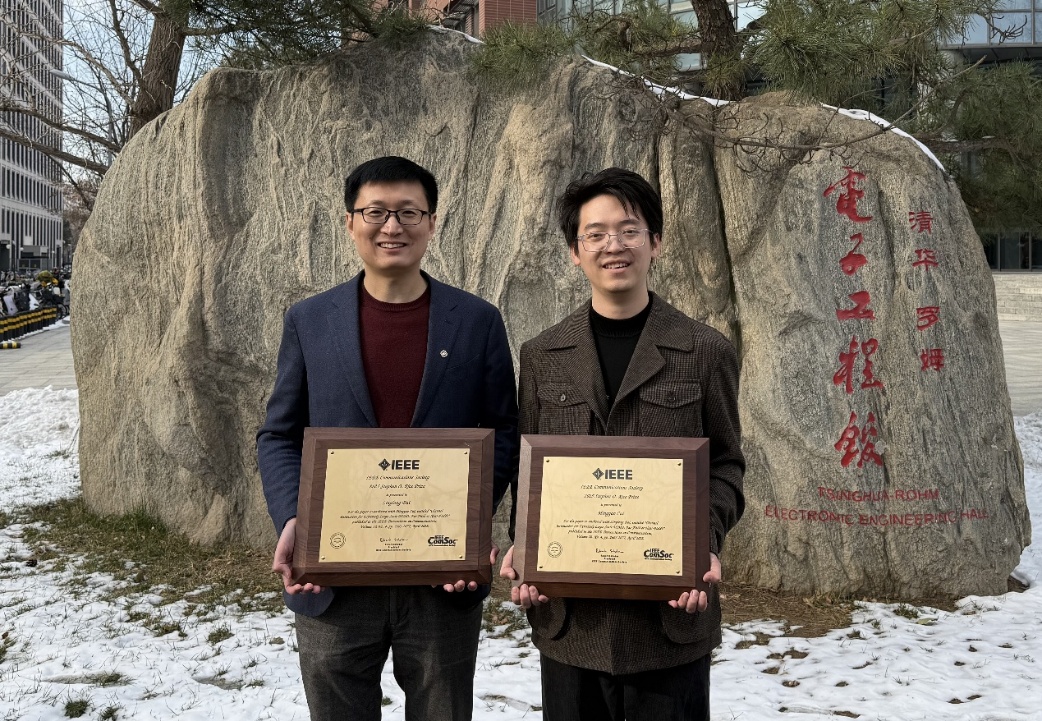
Research team from Tsinghua wins 2025 IEEE ComSoc Stephen O. Rice Prize
The traditional 1G to 5G systems are built on far-field communication principles, which rely on a planar electromagnetic wavefront model and utilize only the angular-domain degrees-of-freedom (DoFs) of wireless channels. This design presents a fundamental bottleneck for further performance enhancement. The award-winning paper is among the first seminal works exploring near-field communications in 6G systems. In near-field scenarios, electromagnetic waves behave as spherical wavefronts. This property unlocks an additional distance-domain DoFs alongside the angular dimension, opening a new pathway to significantly improve 6G spectral efficiency. Near-field technology is now widely recognized as a potential key air-interface innovation in 6G systems. In March 2025, China’s IMT-2030 (6G) Promotion Group established the Near-Field Communications Task Group, with Tsinghua University serving as the leading institution, to steer the 6G standardization of near-field communications. In August 2025, the international standardization organization 3GPP formally adopted the near-field channel model for new 6G mid-band frequencies (7-24 GHz), paving the way for further research and application of near-field communications for 6G.
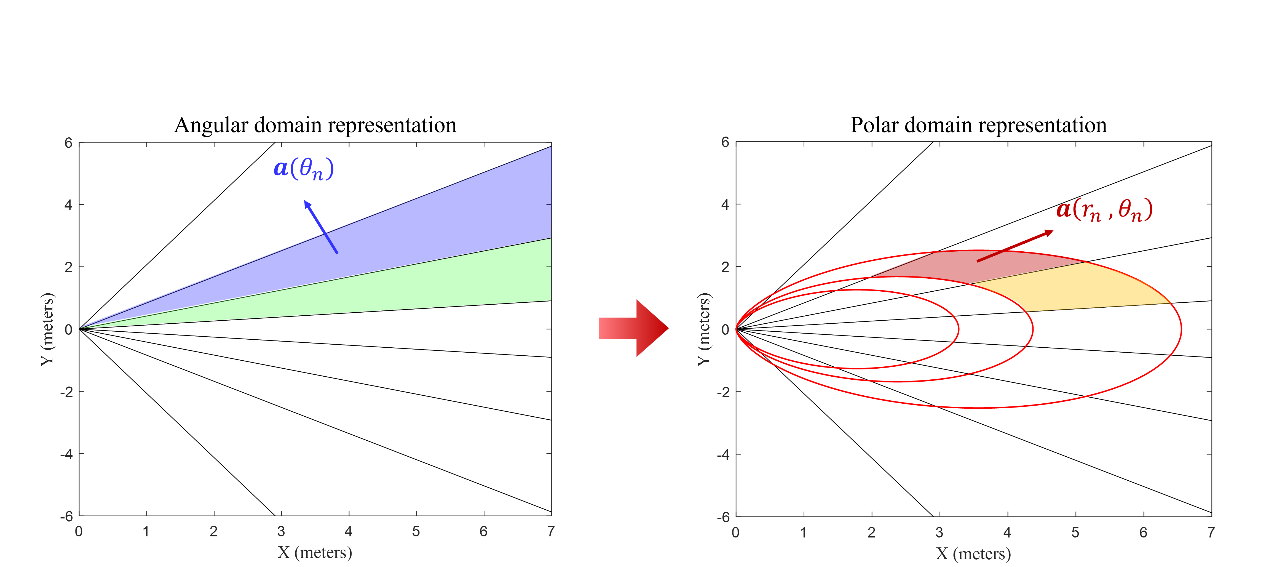
Angular domain representation vs. polar domain representation
The core innovation of the paper is a novel polar-domain channel representation method tailored for near-field communications. While existing 5G massive MIMO systems use an angular-domain representation method that uniformly divides the angular space, the proposed approach introduces non-uniform sampling in the distance-domain. This dual focus efficiently captures the full spatial characteristics of the near-field channel. Based on the Fresnel approximation, the proposed framework is proven to be applicable to both near-field and far-field propagation environments. The research team then integrated this near-field channel representation with advanced sparse signal recovery algorithms to achieve highly accurate channel estimation. Numerical results demonstrate significant accuracy gains in near-field scenarios, while the method naturally specializes to the conventional far-field estimation when applied in far-field environment.
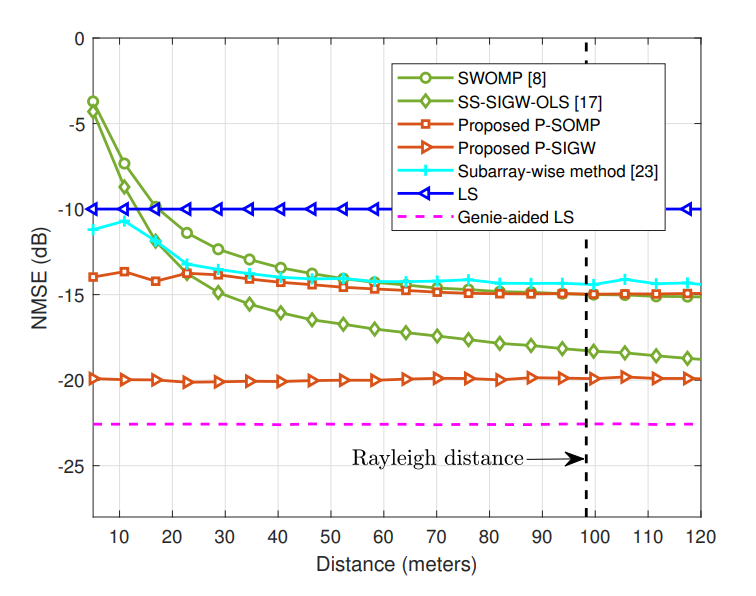
Channel estimation error vs. communication distance.
The awarding paper has received 776 Google Scholar citations since its publication, ranking the second in terms of citations among over 1,800 articles published in IEEE TCOM from 2022 to 2024. The proposed polar-domain representation method has been directly adopted or extended by more than 100 research teams from over 30 institutions worldwide, with applications spanning near-field communications, near-field localization, integrated sensing and communications, physical-layer security, wireless power transfer, and reconfigurable intelligent surfaces.
IEEE ComSoC Stephen O. Rice Prize
Established in 1975, the IEEE Communications Society Rice Award is named after Dr. Stephen O. Rice from Bell Laboratories, who introduced the Rician distribution in statistical theory. This prize is one of the highest honors in the field of communication theory. It is awarded annually to the single best paper published in IEEE Transactions on Communications in the past three years, selected based on academic quality, originality, utility, and timeliness.
Editor: Li Han