An AI race car developed by Tsinghua University has conquered one of the world’s most demanding autonomous driving challenges, achieving a record-setting performance and claiming overall victory at the Hitch Open World AI Championships.
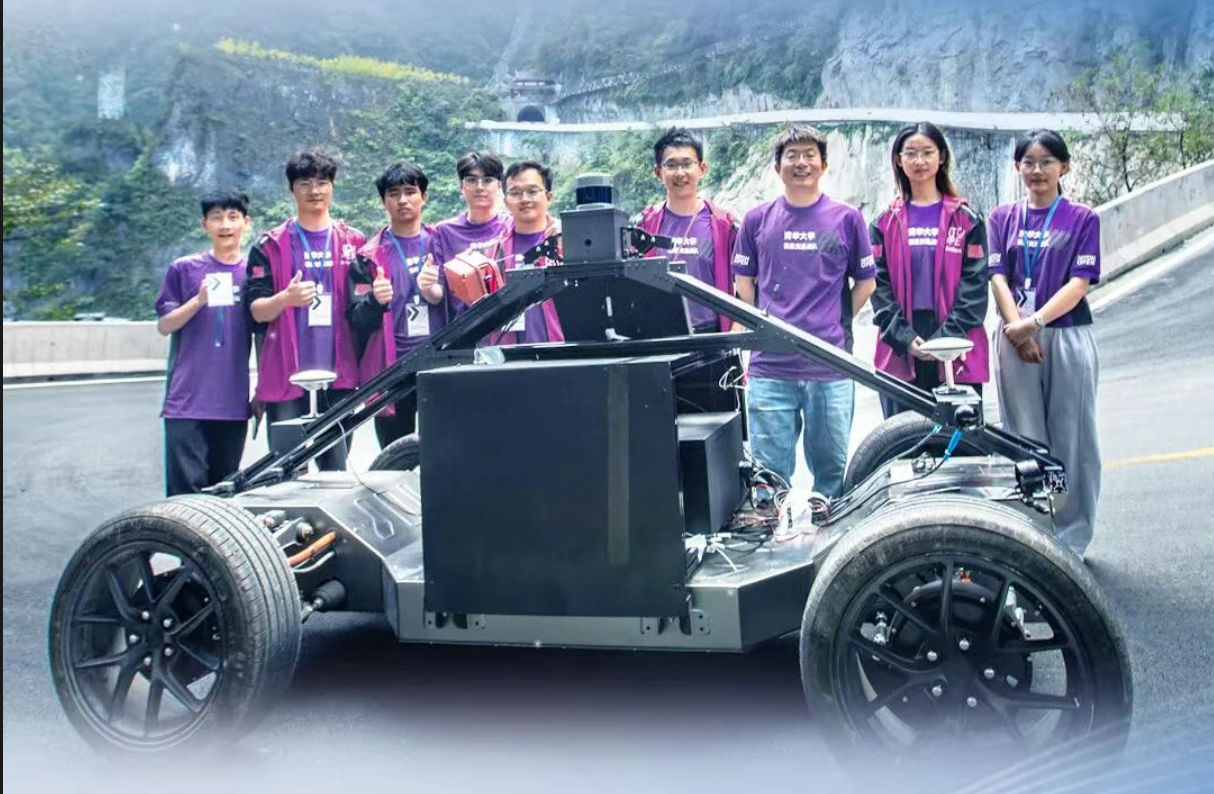
The race took place on the winding mountain road of Tianmen Mountain in Zhangjiajie, Hunan province, known as the “Stairway to Heaven”. The 10-kilometer course features 99 sharp bends and a vertical drop of more than 1,100 meters, posing extreme challenges for perception, localization, decision-making, planning and control. In an environment marked by intermittent signal availability, limited visibility, steep gradients, and tight curves, the Tsinghua AI race car completed the entire course in fully autonomous mode, recording the fastest autonomous lap time on the course at 16 minutes and 10 seconds.
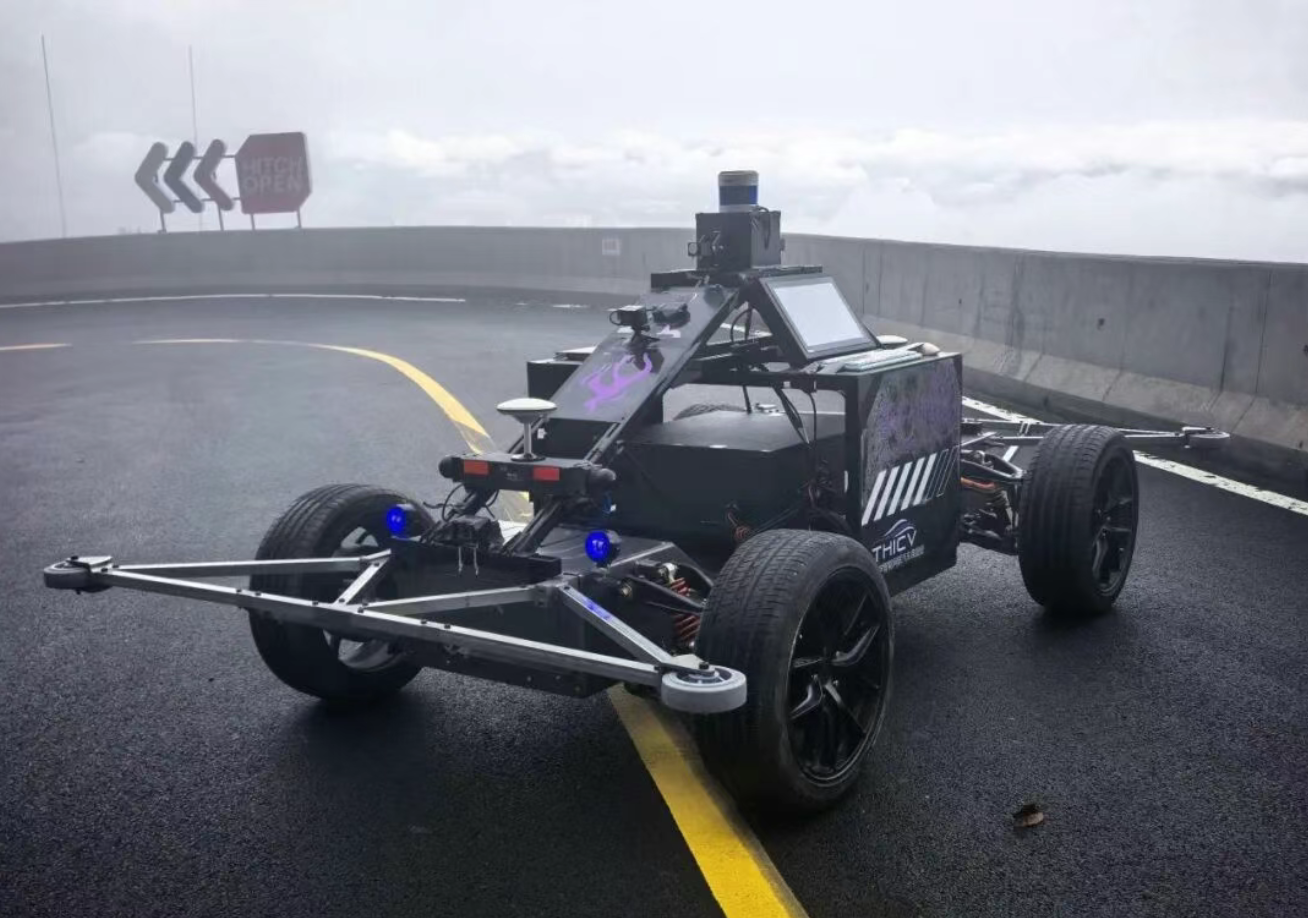
With high-precision localization and low-latency decision-making, the team achieved first place in both the simulation and real-vehicle races, winning the championship by a decisive margin. The team also set a new speed record for AI-driven vehicles on a steep mountain track with 99 curves.
Testing the limits of autonomous driving
Early on the morning of October 14, thick fog enveloped Tianmen Mountain as the starting signal was given. The AI race car shot off the line and soon entered a tunnel after the first hairpin turn. Relying on multi-sensor fusion and robust localization, the vehicle maintained accurate state estimation in the tunnel’s blind zone before exiting smoothly onto a downhill section.
With wet road surfaces increasing the risk of skidding, advanced reinforcement learning algorithms and predictive control strategies ensured stable tire-road interaction. The car navigated the winding course with precise cornering and continuous, well-planned trajectories, crossing the finish line to roaring applause as the time was announced.
Tianmen Mountain is widely regarded as one of the most challenging real-world testing grounds for autonomous driving, pushing AI systems to their limits in perception, localization, planning, and control simultaneously.
Developing localization algorithms under extreme pressure
The team was formed in late March 2025, with only two weeks remaining before the championship officially began. Over a six-month competition cycle, many team members had to learn critical skills from scratch while preparing for the race.
Localization proved to be one of the most critical and difficult tasks. Without a human driver, the autonomous vehicle needed to determine its precise state in real time to support safe planning, risk avoidance, and control.
Graduate student Fu Shangyu, a master’s student from Tsinghua’s School of Vehicle and Mobility, took on the localization task despite having no prior experience in C++ or localization algorithm development. He partnered with doctoral student Zou Hengduo, who had a strong background in computer vision but had never worked on localization in complex mountainous terrain.
During early real-vehicle tests, the team encountered a major setback: the car stalled after just three kilometers due to delays in loading the full 3D point-cloud map. Localization update frequency dropped sharply, rendering the approach unsuitable for Tianmen Mountain’s large-scale and complex mapping environment.
After collective discussions, the team proposed a breakthrough solution—dynamically loading only local map data around the vehicle, much like assembling a puzzle piece by piece. This local map dynamic loading algorithm became the key to overcoming the bottleneck.
In October, as temperatures on the mountain dropped sharply, team members began their days at 4:30 a.m., traveling to elevations above 1,300 meters to fine-tune parameters and prepare the car. Even with numb fingers and freezing winds, they persisted. “Senior teammates and the team leader guided me remotely through system setup and debugging—it made me feel truly supported,” Fu recalled. Their perseverance ultimately gave the AI car its precise “eyes”.
Proving technology on the track
Team leader Qi Xiaojing, a master’s student, had long hoped to move beyond theoretical research and laboratory validation. This competition offered him the opportunity to test algorithms under real extreme conditions.
During the simulation phase, the team attempted to transfer urban-road planning and control algorithms to the mountain environment, only to discover that methods proven in cities failed under extreme terrain. While other teams broke the 60-second mark per lap, Tsinghua’s early simulations lagged behind, forcing a complete rethink.
To fully understand the track, Qi conducted “human-and-car” tests, running alongside the AI vehicle on steep slopes and sharp curves to record real-time feedback. Over time, he wore out two pairs of running shoes. Through repeated validation, the team integrated every curve angle, slope gradient, and road friction coefficient into their models, reducing trajectory deviation from the planned path to within 20 centimeters.
The process marked a turning point, transforming simulation results into reliable real-world performance and deepening the team’s understanding of autonomous driving in extreme environments.
Defining future research directions
Doctoral student Leng Jiatong, responsible for chassis tuning, identified a critical gap between algorithm design and hardware limits. Drawing on her background in vehicle dynamics, she worked to align AI control strategies with the car’s physical capabilities, enhancing stability under extreme conditions.
The competition prompted her to rethink her research direction, combining vehicle dynamics with AI-based learning methods to improve control and safety in challenging scenarios.
Witnessing multiple teams lose control due to extreme weather further reinforced the importance of vehicle safety. Several Tsinghua team members have since decided to focus their future research on autonomous driving safety. Zou plans to improve the robustness of localization systems, while Lyu Yao aims to address safety challenges in urban autonomous driving through data-driven optimization.
Guided by mentors, looking ahead
The team’s success was supported by close guidance from faculty members, including Professor Li Shengbo, Associate Researcher Yu Liangyao, and Associate Researcher Gao Bolin, who provided step-by-step support in simulation, real-vehicle testing, and on-site track analysis.
As the AI race car emerged from the fog and sunlight broke through the clouds over Tianmen Mountain, the team’s research journey entered a new stage. Building on this extreme racing challenge, the team aims to advance autonomous driving technologies for complex real-world environments—continuing to explore, innovate, and expand the boundaries of intelligent mobility.
Editor: Li Han