The team from School of Aerospace Engineering of Tsinghua University recently won the championship with their outstanding score in the 13th Global Trajectory Optimisation Competition (GTOC). The team also won the right to host the 14th edition of the competition.
This edition of competition attracted 101 teams from all over the world to participate. The theme of this competition is " Humanity’s First Robotic Exploration of a Hypothetical Exoplanetary System". Participants are required to design the flight trajectory of spacecraft with maximal scientific value, flying over the 310 planets, dwarf planets, asteroids, and comets orbiting the star Altaira as many and widely as possible. Meanwhile, the spacecraft is limited to performing only orbital maneuvers using planetary gravity assists and solar sail pressure. The problem involves the challenging problem of multi-target trajectory optimization with advanced propulsion methods.
The Tsinghua team was composed of members from the research group leading by Prof. Baoyin Hexi, including Prof. Jiang Fanghua (Team Leader), Dr. Zhang Nan (Coach), and students Song Jialong (Captain), Tao Yuming, Li Rundao, Zhou Yi, Qin Yiyang, Kinthong Lee, and Wu Yixuan.
To tackle the complex problem related to the hybrid propulsion of solar sail propulsion and multiple planetary gravity assists, the team developed on the spot a novel intelligent trajectory design framework. This framework was used to efficiently search for the optimal solution among hundreds of millions of possible flight trajectories, ultimately working out an extreme exploration trajectory that flew over 150 celestial bodies. The solution trajectory received the highest score after the quantitative evaluation, ranking first in both the number of celestial bodies visited and the total scientific return.
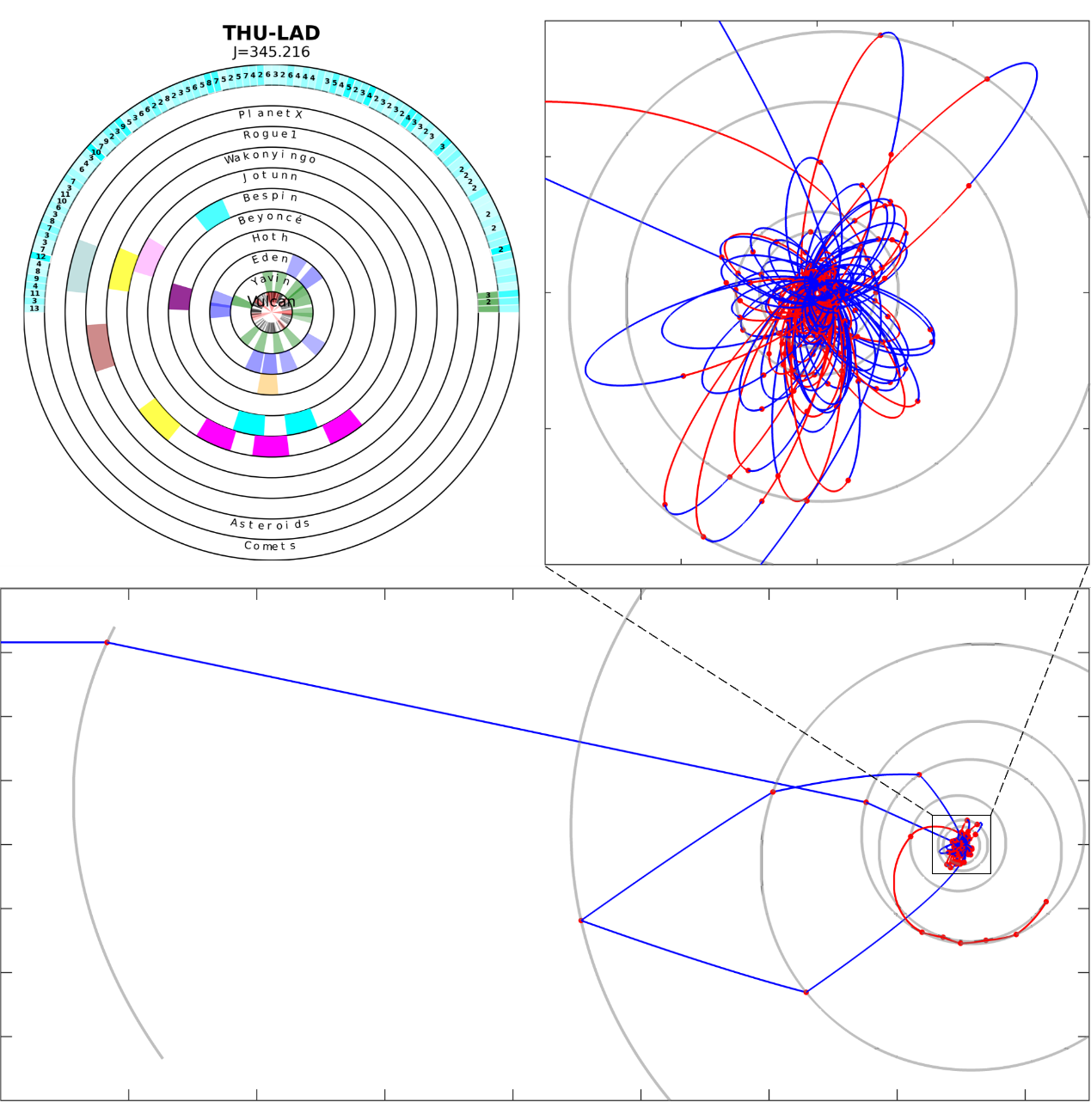
Tsinghua team’s final results (the statistical chart in the upper left is sourced from the competition website)
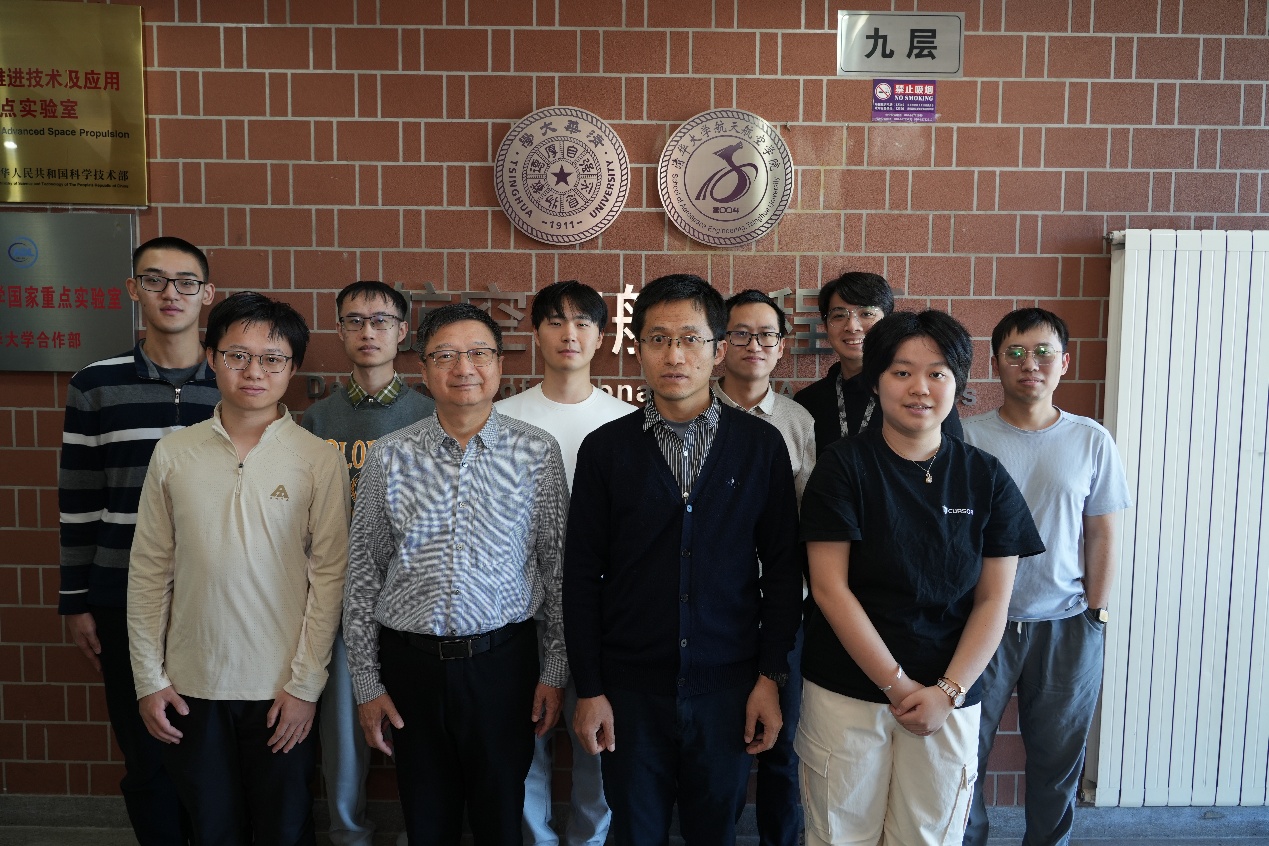
Team members assemble for a group photo.
The GTOC was initiated by the European Space Agency (ESA) in 2005. This is a high-level, professional, and international event, regarded as the most top-level competition in the field of space mission design, and often referred to as the "Olympics of space mission design". The competition is held every one to two years and lasts for four weeks. It aims to invite the world's most outstanding astrodynamics experts and mathematicians to challenge the "nearly impossible" complex task optimization design problems in space exploration. The team from Tsinghua University had already won the championship in the 11th edition of the competition in 2021.
Editor: Li Han