The 2026 International Congress of Basic Science (ICBS 2026) opened on August 9 at the Beijing Yanqi Lake International Convention and Exhibition Center.
Attending the opening ceremony were Yin Li, secretary of the CPC Beijing Municipal Committee; Yin Yong, deputy secretary of the CPC Beijing Municipal Committee and mayor of Beijing; Zhang Guangjun, vice minister of science and technology; Feng Shenhong, vice president of the China Association for Science and Technology; Li Luming, president of Tsinghua University; Wang Hongwei, vice president of Tsinghua University; Fields Medalists Shing-Tung Yau, Maxim Kontsevich, Martin Hairer and Caucher Birkar; and Turing Award laureate Robert Tarjan, among others.
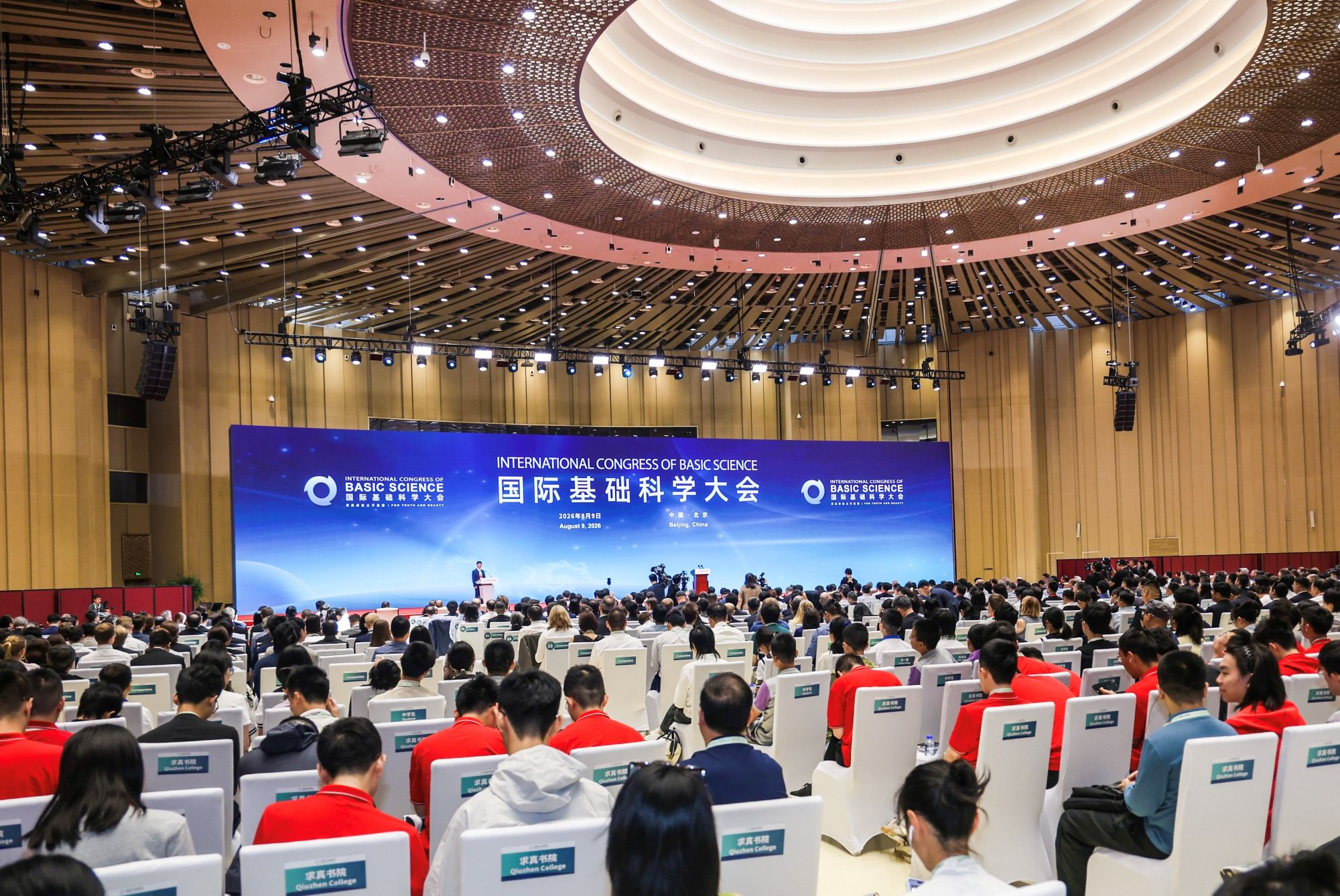
The opening ceremony of the 2026 International Congress of Basic Science in Beijing
In his remarks, Yin Li welcomed scientists and experts from China and abroad to Beijing for the congress. He said that global scientific and technological innovation is entering a phase of intensive and dynamic activity. Profound changes are taking place in the paradigms of basic scientific research. These changes are accelerating interdisciplinary integration and cross‑sector collaboration and innovation, alongside continued breakthroughs in frontier fields. President Xi Jinping has pointed out that mankind needs international cooperation, openness and sharing more than ever in order to address common development problems. Beijing is a vibrant international metropolis where ancient and modern cultures converge, as well as fertile ground for scientific and technological innovation and talent development. At present and in the period ahead, Beijing is committed to accelerating the development of itself into an international center for scientific and technological innovation and a high-level hub for talent.
He expressed hope for joint efforts to advance human progress, identify major scientific questions, promote breakthroughs in cutting-edge theories, and continuously produce more original achievements, so that scientific progress can better benefit people around the world.
He stressed the importance of fostering a world-class research environment, developing policies aligned with the long-term nature of basic research, and building systematic platforms for cultivating talent in basic research, thereby laying a solid foundation for innovation and creating a fertile environment for the development of basic science.
He called for promoting openness and sharing, jointly deepening international exchanges and cooperation, jointly implementing major science programs, improving the system of international science and technology governance, and working together to advance global scientific and technological progress.
On behalf of Tsinghua University, Li Luming welcomed the Chinese and international scientists attending the event. He noted that, with the advent of the artificial intelligence era, scientific research paradigms are undergoing profound changes, and that leading research universities should play a stronger role as the main force in advancing basic research. In recent years, Tsinghua University has continued to increase investment in fundamental disciplines. The University has attracted a group of world-class researchers and promoted the use of artificial intelligence to empower scientific research. It has also strengthened its capacity for independent talent cultivation and achieved fruitful results through its comprehensive efforts in basic research. Looking ahead, Tsinghua will work with colleagues from across different fields to strengthen its capacity for original innovation, cultivate future talent for basic research, and make greater contributions to expanding the frontiers of human knowledge and advancing human civilization.
Shing-Tung Yau, president of the International Congress of Basic Science, director of the Yau Mathematical Sciences Center at Tsinghua University, and dean of Qiuzhen College, said that China is providing unprecedented support for basic research and has become a fertile ground for the vigorous development of basic research worldwide.
Faced with the wave of artificial intelligence sweeping across all fields, AI cannot replace the uniquely human capacity for original thinking, the flashes of inspiration that arise in an instant, or humanity’s enduring pursuit of scientific truth and the beauty of nature. Major advances in basic science have always relied on the cross-fertilization of ideas across disciplines and the courage of human beings to explore the unknown.
The opening ceremony also featured the presentation of the ICBS Medal and the Frontier Science Award.
The ICBS Medal is divided into three fields—mathematics, physics and engineering. Nine scholars received the medal: Claire Voisin, Horng-Tzer Yau, Zhang Shouwu, Andrea J. Liu, Wang Yifang, Wen Xiao-gang, Bao Zhenan, Zhuang Xiaowei and Zhang Feng.
A total of 111 high-level original research papers were selected for the Frontier Science Award, covering 40 subfields across mathematics, physics and information engineering. The award-winning authors come from universities, research institutions and technology companies in more than 20 countries and regions. Five Tsinghua University scholars and two papers received the award.
More than 80 recipients of prestigious international awards, including the Shaw Prize, the Wolf Prize and the Dirac Medal, as well as members of national academies from China and abroad; more than 400 internationally renowned scholars; and more than 800 researchers and young scholars from universities, academic organizations and research institutions in more than 30 countries attended the opening ceremony.
The International Congress of Basic Science (ICBS) was initiated by Shing-Tung Yau in 2023, and this year marks the fourth time the congress has been held in Beijing. The theme of this year’s congress is “Advancing Basic Science for Humanity”
The congress is jointly sponsored by the Beijing Municipal Government, the Ministry of Science and Technology, the China Association for Science and Technology, and the International Consortium of Chinese Mathematicians. It is organized by the Beijing Municipal Science and Technology Commission and Zhongguancun Science Park, the Beijing Association for Science and Technology, the Huairou District Government, the Huairou Science City Administrative Committee, and the Beijing Institute of Mathematical Sciences and Applications, with the Yau Mathematical Sciences Center at Tsinghua University as a co-organizer.
Over the two-week congress, more than 500 academic forums will be held, covering all branches and interdisciplinary areas of basic science, as well as cutting-edge topics including reasoning with generative large models, computer vision, human-computer interaction and quantum information.
Alongside promoting high-level academic exchange, the congress continues to improve the ecosystem for nurturing young scientific talent. A range of themed activities will be introduced, including “Tsinghua Day” and the “Basic Science and Artificial Intelligence Forum” The congress will also feature an academic poster exhibition and a “Face-to-Face with Scientists” program, as well as a Women Scientists Forum and the launch of the Innovative Scholars Program.
Editors: Li Han, John Paul Grima